Medieval Merriment with the Minstrels

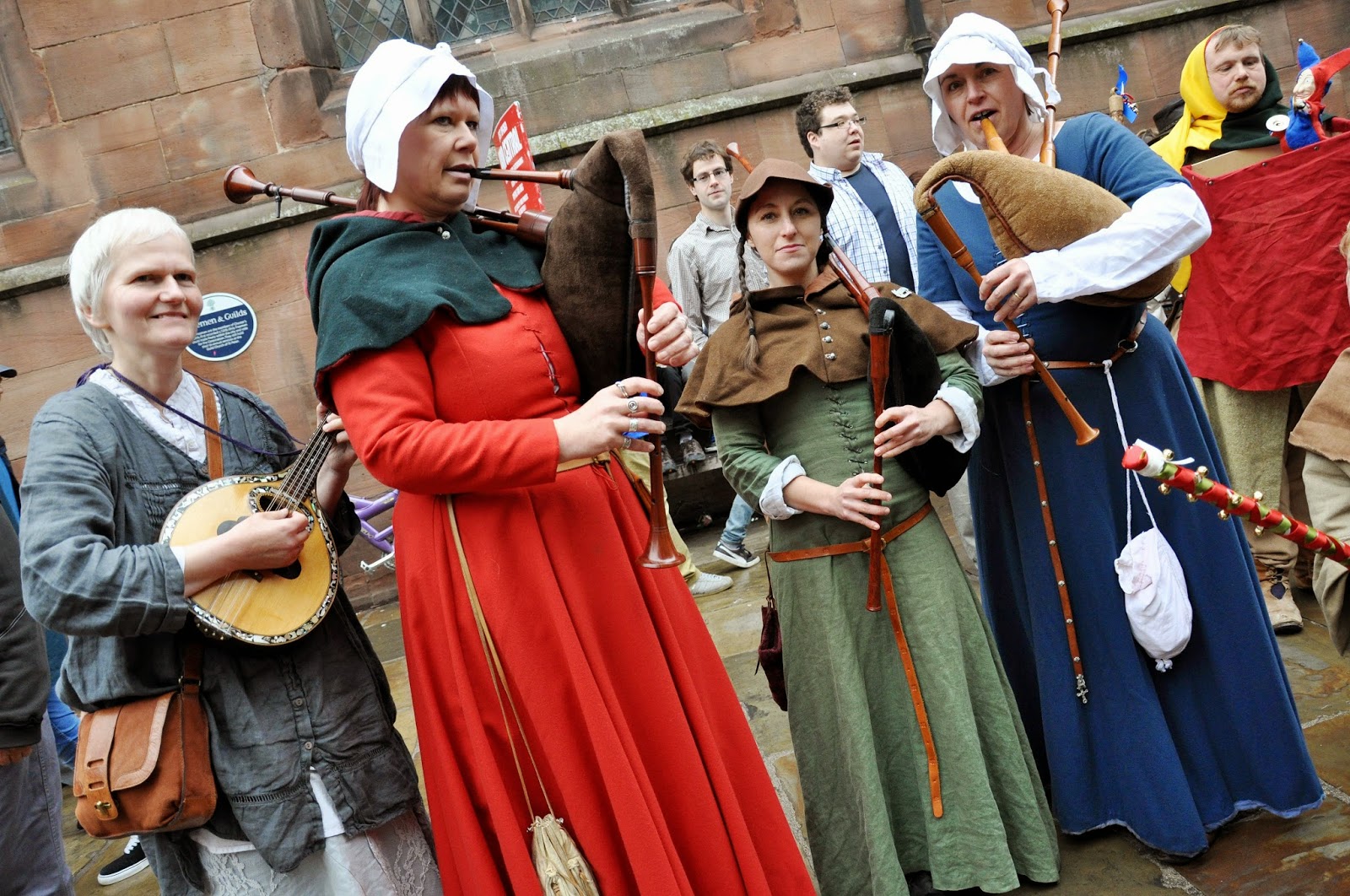
This post is rather belated, though I have shared these pictures elsewhere.  Anyway, this year's Minstrels' Court was another enormous success.  Sue and I (Pilgrims and Posies) organise it in conjunction with the local museum and St John's Church, but it only works due to the wonderful support of the very talented musicians who came from across the UK to help this very special event and enjoy a day of music together.  It is Britain's biggest gathering of medieval musicians and great fun for minstrels and visitors alike.
 
An informal session in the church porch as the day begins.
 
Tom telling the Musicians of Bremen story.
Visitors trying out some medieval board games.
 
Minstrels share news of their new instruments.
 
 
Tom Goodale tells a tale from King Arthur's Court
 
Demonstrating braiding.
 
A knight is armed.
 
The scribe is at work recording the events of the day.
 
Braiding and gossiping.
 
Minstrels processing up Bridge Street.


Minstrels playing at the Cross in the heart of Chester.
 
 
Minstrels at the East Gate of the city.
 
Heading back to the church.
 
A guard waits for the returning minstrels.
 
The gathered minstrels kneel in deference at the altar.
 
Rev David Chesters issues the licences to minstrels.
 
 
A troublesome musitioner is placed in the stocks.
 
The Time Bandits perform a mini-concert as the medieval musicians take a rest after processing.


Summons to the Minstrels' Court

This time of year I find myself excited about the approaching Minstrels' Court and the gathering of so many like minded musicians, living history folk and storytellers, all friends.  Yet, there's also a fair bit of organising to do, and not a little battling with bureaucrats who don't necessarily like the tradition, or indeed understand it.  Each year I wonder whether it will be possible to stage it in future and whether I can face the job of putting it together, but then I remember the story, the tradition, the friends and the fun and it's easy to forget the rest.
 
Now it's only a week and a half to the big day... You are invited of course.
 
Since we first revived the tradition in 2008 it has grown a bit each year and we can now happily call it Britain's biggest medieval music event.
I'm sure many of you will know the legend behind the origin of the Minstrels' Court, but for those who are new to it, here's what I've written about it in the past.
 
And if you want to see what's happened in previous years, we've written about that too!
 
This year, the Minstrels' Court takes place on Saturday 28th June, from 10.30am to 5pm, all in the original and atmospheric location of St John's Church, Chester.  We will be processing through the streets from 1pm to 1.30pm when we return to the church to get our minstrels licences in a recreation of the original ceremony.  There's music from dozens of medieval performers, living history demonstrations, storytelling, children's activities and all of the daytime events are free!
 
Then at 7.30pm, also in the church, there is a concert with Richard and Elizabeth York playing beautiful medieval harp duet, Chester's very own Time Bandits with their lively versions of tunes from medieval to 18th century and Blast from the Past who are one of the country's foremost historic music acts, very upbeat, fun and amazing musicians with it.  These evening concerts have become a highlight in Chester's traditional music calendar and a real treat.  You can get tickets on the door for £5.
 
So do please come along if you can and help to make this a really special day.

That Strange Music - So Darkly Sweet

Back in the summer of last year, we were in Shropshire for a few days exploring before going to Festival at the Edge, the wonderful storytelling and music gathering there. In museums and little towns, we found mentions of Mary Webb, a writer and novelist of the early 20th century who lived in the area and evoked the landscape, traditions and folklore of her native Shropshire in her writings. I confess that neither of us had heard of her before, though her writings are widely known amongst people living in the local area. Sue bought several of her novels in a second hand shop, and has read all of her published writings since then, and now has ended up as a committee member of the Mary Webb Society!
 
We met with a few friends at Festival at the Edge, and one of the highlights of the festival was a performance at the music tent – ‘The Lives and Loves of Mary Webb’ by Beguildy, a duo comprising Anne Marie Summers and Janie Mitchell. Their singing was beautiful and, though they played a good variety of instruments, Anne Marie didn’t play any of her bagpipes for this performance. The songs were actually poems by Mary Webb which they had collected and set to music, it really was a moving and memorable experience and I’m sure I wasn’t the only one who left with tears in my eyes.
But how does any of this relate to bagpipes? Well, in reading her novels, poems and essays, we came across a few mentions of bagpipes. They come from works published in 1917, when we might expect references to reflect the strident sound of Highland pipes or a military aspect, but instead two of the references remark upon the enchanting and hypnotic nature of the bagpipe.
 
Firstly though, a more usual, slightly disparaging view of a bagpipe’s tone, from her novel Gone to Earth.
 
The one-eyed cat was beside her, blue-ribboned, purring her best, which was like a broken bagpipe on account of her stormy youth.”
 
But later in the same work, she relates a softer, humming tone of a pipe when relating a visit of some of the characters to the bees in a walled garden.
 
she could hear the queen in one hive ‘zeep-zeeping’ – that strange music which, like the maddeningly soft skirl of bagpipes, or the fiddling of Ned Pugh, has power to lure living creatures away from comfort and full hives into the unknown – so darkly sweet”
 
A similar reference appears in Mary Webb’s collection of nature essays published as ‘The Spring of Joy’ in the same year, 1917.
 
“There the queen bee with her strange, low piping – a mere breath of sound, but stirring the same frenzy as bagpipes played softly before a battle – wakens madness in her followers, and lures them through the gates of adventure as Ned Puw's fiddle inveigled folk through the gates of Faery.”
 
The Ned Pugh, or Ned Puw, she refers to is the character in folk tale of the Shropshire/Wales border, usually a fiddler, though on rare occasion called a piper, who boldly or foolishly, ventures into a cave which leads to the land of the fairies and is never seen again, though his music is often heard under the ground.
 
So, there are only a few references, but I thought them worth sharing as they are some evidence that people were aware of the sweet sound of bagpipes in early 20th century Shropshire, and that I do like the description ‘That strange music – so darkly sweet’.

More mummery...

Here in Cheshire we do our mummers plays around All Souls Day and they're called Soul Caking plays, (regular readers of this blog will know all about our long standing connections with Jones' Ale Soul Cakers in Chester), but over in the Pennines they do some funny things, so there the plays take place near Easter and are called Pace Egg plays. 


Well, as yesterday was Good Friday,we headed over to Heptonstall to see the Pace Egg play.  We stopped in Hebden Bridge a while, caught a street performance of a Pace Egg play by some young lads, had lunch at the ever excellent Greens Vegetarian CafĂ©, then set off for the very steep walk up The Buttress to the hilltop village of Heptonstall. 
 
The place was packed, several hundred people had turned out to see this annual tradition.  In this respect it is very different to our performances in Chester, where half of the idea is to surprise unwitting drinkers and expose them to a bit of tradition they haven't encountered before.  But I do like the idea of playing to an enormous crowd who have turned up because they want to see it happen.
 
Before the play began there was some morris dancing by the Hill Millies, a local women's side dancing the Cotswold tradition but notable for their costume of cleaner's tabard and headscarf and yellow dusters in place of white handkerchiefs. 
 
 
Then into the cobbled square processed the Pace Eggers, and began their play.  It's broadly similar to the soul caking plays of Cheshire, St George encounters various foes, who challenge him, one is killed and resurrected by a doctor, and a fool character enters last of all to conclude the play and begin the collection.  In Chester this fool is Beelzebub, in Heptonstall he's Toss Pot.  There are a couple more character than "our" play, but it is perhaps fitting to find that Andy Carter, a friend I met through shared interest in bagpipes, turns out to be the regular Prince Paradise at Heptonstall, the same role which I've most commonly played in Chester.


The setting is perfect, especially on a gloriously sunny day as it was, the crowd, easily three hundred people, help shape the performance space, and instead of the confines of a pub performance which I'm used to, the Pace Eggers have a wide cobbled space to make free with much more waving of swords, juggling and very convincing fights. 
 
 
They are great performers, and this is a very friendly community tradition in a beautiful place.  It's been several years since we last watched it there, I don't intend the gap to be so long next time.


To a Haggis

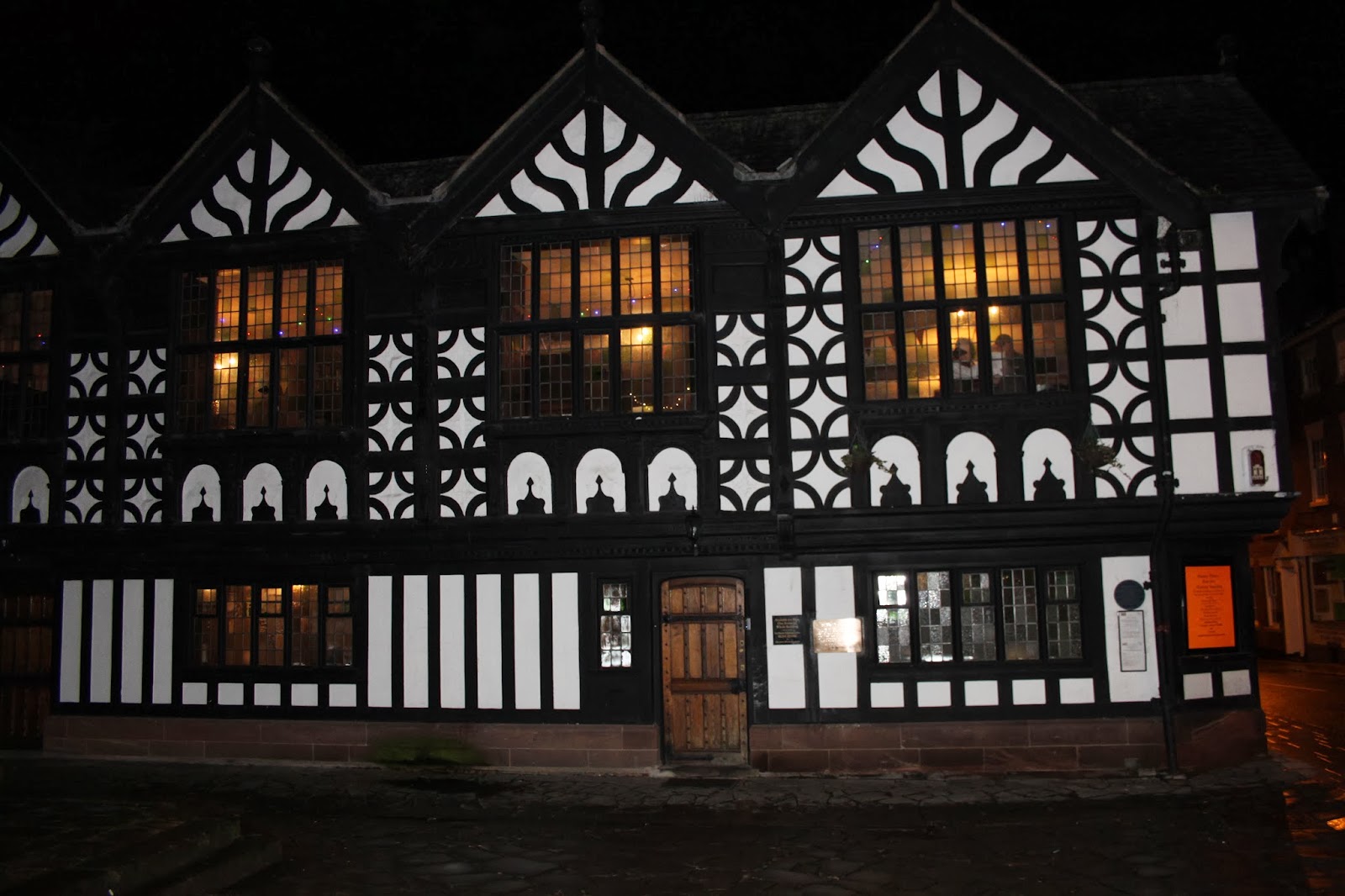
Yesterday it was Burns Night, when we are normally invited to share the evening with a gathering at a friend's house, but last year our little group decided to make the event a bit more special and so hired out the lovely Stanley Palace in Chester.  There had been a lot of planning going on to make it extra special this time.
Guests were bringing plates of food to share and so Sue was on duty arranging all of this...
Haggis, neeps and tatties were being prepared in the kitchen beside the beer... 

Fairy lights and tartan bunting were arranged throughout the building and it was nearly time to begin welcoming all the guests...

I regularly tell people that not all bagpipes are Scottish, but for this event I did dress the pipes up a bit...
At 8 o'clock the haggis was piped through the building...

We played the tune for a Burns' song 'A man's a man for a'that'.
Of course we had the 'Address To A Haggis'...
Then, as is now a tradition at our Burns Night celebrations in Chester, there was a little extra play on the story of the haggis.  This year it was a tale of how the haggis was once a widespread dish across Britain and how it came to be just a Scottish favourite.  It was a tale of medieval mystery, of secret societies, the gastronomic occult, exiled Italian abbots running coffee shops, archaeological discoveries and the revelation that the true origins of the haggis had been disguised in the words of a mummers' play.  Whether the gathering believed all of this, I'm not too sure...
The newly rediscovered play was enacted for the first occasion in modern times; Here's Haggis and Trencher...
And then Bread and Tripe ready to pounce with the knife...
Then it was time to judge the best dressed tankard competition... 
Followed by a Burns' song 'The Winter it is Past'...
 
And then it was off to eat, share stories, catch up with friends, play music and dance for the rest of the night.  The camera was put away then so you'll have to imagine all that.
 
Maybe it wasn't the most 'authentic' Burns supper, but the mood of sharing an evening with friends, music and song felt like an appropriate way to celebrate the event.

What's in the Well?

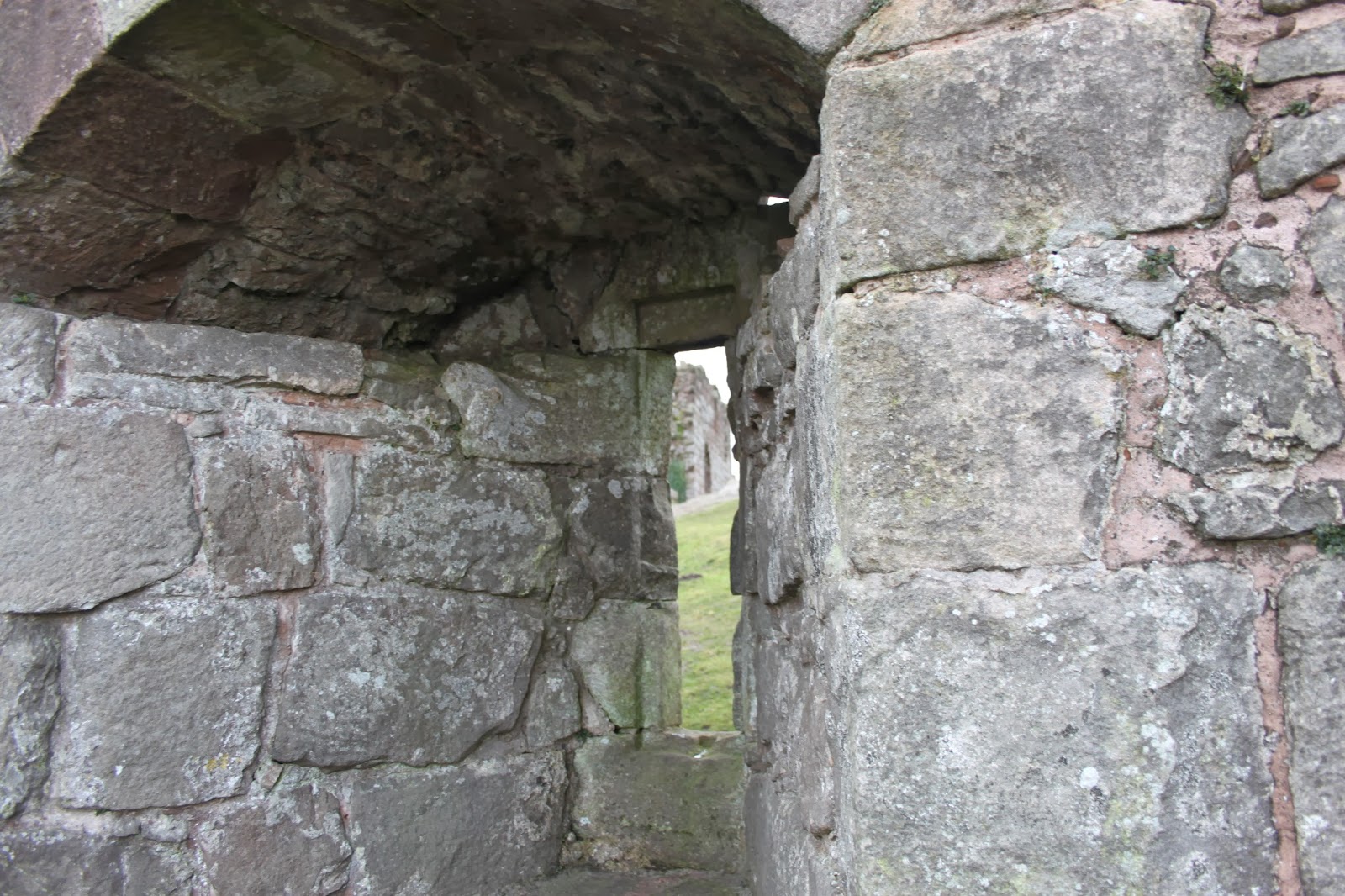
Recently we returned to Beeston Castle, to climb the crag and look out over the Cheshire plain.  The moles had been busy and we stopped regularly on the walk up to examine the miniature spoil heaps of their excavations for any traces of archaeology and were rewarded with a few sherds of 17th century slipware and blackware.  But it was also a trip to return to the well inside the inner bailey at the top.


The view from the top.  The white dot just about visible in the middle is the Lovell Radio Telescope at Jodrell Bank
There had been a hillfort at Beeston in the Iron Age but in the 1220s a castle was begun on the crag by Ranulf de Blundeville, the same Earl of Chester who, some will recall, had been saved from a siege by the musitioners of Chester and whereby the tradition of the Minstrels' Court began

Inside the inner bailey is a well, just as you expect to find in a castle.  But, with the location of the castle atop this rock, it is very deep, the deepest in Cheshire and one of the deepest castle wells in England.  It is supposed to reach down 365 feet which, being the same number of feet deep as days in a year, seems to have been picked to give the well more of a mythic quality.  And it does have a legend associated with it...

In 1399, King Richard II who was much beloved in Cheshire, though not well supported in the rest of his kingdom, travelled from Chester to Ireland in an attempt to reassert his authority there.  Before leaving he hid his Royal treasure at the bottom of the well at Beeston.  When Richard returned from Ireland via Wales he met with a challenge to the throne from his cousin Henry Bolingbroke and was imprisoned, deposed and eventually starved to death at Pontefract Castle, (he presumably didn't find the stash of liquorice there).  But the treasure was left unclaimed at the bottom of Beeston Castle well and some say it is still there, guarded by a demon.

Richard II, accompanied by his bodyguard of Cheshire Archers, riding through Chester's Water Gate en route to Ireland
Now, this is where I come into the story.  Eight years ago, my brother and I went out for a walk on a winter's day and stopped at the Dysart Arms at Bunbury for lunch, though it's important to note that I didn't have a drink.  We then went up to the castle, where we were the only visitors.  At the well we decided to drop in a coin to see how deep it was.  After a long pause, it is a deep well, we heard "grrr".  So, of course we had to do it again.  Another pause, then "Grrrrr!".  Then once again, and this would be the last time because after that I'd only pound coins left, "GGGRRRRR!". 

We made our way back down the hill faster than we might otherwise have done, and looking back behind us a fair few times.  Although we made light of it, saying it was probably an angry badger at the bottom, it was a little unsettling at the time.  Now, it was most likely the distorted echo of the coin falling to the bottom, and our ears getting attuned to it so it seemed to grow louder, but I can certainly see how this could seem like there is a demon in the well.  And if enough people have done what I did, there certainly will be a great treasure at the bottom of the well.