

The Piper's Tale
As regular followers of this blog will know, we love traditional folk tales and we love bagpipes. This year Tom will be out and about with his storytelling show - The Piper's Tale. Here's the essence of the performance. Do let us know if you'd like to see it near you...

Plucking a Noodle
Trawling through mentions of 19th century pipers in Chester and found this from the Chester Chronicle 26 April 1833, admittedly there's only a brief mention of bagpipes and the music, but the story is a familiar one from folk songs. And the epilogue shows a firm belief in witchcraft even at this date.
PLUCKING A NOODLE - A countryman named Francis Hanmer who said he came from Bryngwylla near Oswestry, charged Ruth Jones, a female of common repute, with stealing his watch. The complainant said he came to Chester on 27th February last, to sell a horse for his master, Mr. Lewis, of the Brook House, near Oswestry. In the evening he strolled out into Eastgate-street, where he met with Miss Jones, who invited her to accompany her to the Three Tuns in Frodsham-street. He, not liking to refuse Jones's request, went with her to the Tuns, where he found a number of Cyprians, engaged in a mazy dance. Aroused by the discordant squeakings of the Irish bag-pipes, on which a fellow was discoursing a most exhilarating music, he rose up from his seat and, as he expressed it, "had a bit of a hop - a three-handed reel with four females and during this time I lost my watch". He could not swear that she took it from him, but she was the nearest to him while engaged in the dance.
Alderman Morris (addressing Hanmer) asked him if he were married. Hanmer with a sheepish look replied "Oh yes Sir, I have a wife and five children". - Ald. Morris, "You ought to be ashamed of yourself for being in such company. What will your wife say when she hears of this transaction?" Hanmer, "I'll not tell her anything about it" - As there was no evidence to prove that Jones stole the watch, she was discharged.
Hanmer visited the police office on Sunday evening, and while there he told one of the officers, that if the magistrates did not commit Ruth Jones, there was a "cunning fellow" (a sorcerer) that lived in his neighbourhood, and that he would engage him to bewitch Ruth: and that he would bring her, watch and all, across hedge and ditch, flying from Chester to Bryngwylla. One thing is quite clear, poor Hanmer is no conjuror!

The Wedding Dance
Now here was a time to
celebrate! A wedding to join two of the bonniest young people you
would ever know. And all the village was there, and folk from
further off too, all come for the festivities. And there had to be
music for the dancing, so they called for a piper. He played such
merry tunes that even the old aunts hopped to their feet to dance
together with sober cousins.
All evening, one dance
followed another, but then it drew close to midnight and the next day
being the Sabbath, the piper told them he must stop. But the bride,
she had gotten in a whirl with dancing see, finding such joy she’d
never known before and didn’t want it to stop. She begged the
piper keep playing saying he was the finest in the land.
Some warned her against
this, how it was wrong to dance on the Sabbath, and others drifted
off to their beds. But such is the folly of the young and such was
the vanity of the piper at her flattery that there were many who
continued in their dancing to the sound of the bagpipe.
And as it passed
midnight, a cloud drew over the moon and the tune fell silent. When
next the light shone, there were the dancers in a circle but standing
still. They had been turned to stone, and the piper also.
And there they are
today, as a reminder to all. So if you hear the hum of a drone, or a
sweet melody as the wind whistles through the stones, you shall know
why.
There are several stone
circles which have this legendary origin, amongst them The Merry
Maidens in Cornwall, The Pipers Stones in County Wicklow and Stanton
Drew Stone Circle in Somerset. This is my retelling of the tale.

Of Pigs and Pipes
After “Are
those Northumbrian pipes?”, probably the next most common question
I get asked when playing in front of the general public is “That’s
made from a pig’s bladder isn’t it?”. I’m sure many other
bagpipers have experienced the same.
It seems
there is quite a strong link between pigs and bagpipes in many
people’s minds, even those who may not have much occasion to think
of the instrument and I often wonder why this should be. To give an
example, a few years ago I was at a fancy dress barbeque – and
although I happily spend most of my working days in some historic
costume or other I still cringe a little at this type of party –
and a session was just starting. Someone arrived who happened to be
dressed as a giant pink pig and spotting my smallpipes he immediately
ran over to me and grabbed the bag wailing, “My brother, what have
you done to my brother?!”
And
it’s not just something that people think these days, the
connection has been around for centuries. I’m sure many pipers
will be aware of the medieval carving of the pig with the bagpipes at
Melrose Abbey, one of the earliest images of bagpipes in Scotland.
It is an iconic image, featuring on the abbey’s postcards and
publicity. I even have a fridge magnet with a sculpted miniature of
this carving.

There
are plenty of bagpiping pigs to be found across England on
misericords from the 14th
and 15th
century, often providing the music for piglets to dance to. These
can be seen in churches in Richmond and Ripon in Yorkshire, Boston in
Lincolnshire and Braddock in Cornwall, as well as Beverley Minster
and Manchester Cathedral. These are fairly well known examples; I
have a resin cast copy of the Ripon carving hanging on my living room
wall. It is possible that some of these could be the work of one
craftsman, but there are enough differences in the style and skill of
the carvings to show that they are not all the work of the same
individual. I’d suggest that this shows a general connection
between pigs and bagpipes, rather than just being a favourite theme
of a single woodcarver.

We
can find other medieval woodcarvings of piping pigs. For example, a
pulpit in St Leonard’s, Ribbesford, in Worcestershire has a pig
playing a double chanter bagpipe which is very similar in design to
the misericord at Ripon, though this version is a flatter relief as
it was formerly part of the rood screen.
And
it’s not just in England that we find this association. There is
an example of Danish bagpiping bacon on a wall painting in Vestervig
church as well as Dutch 15th
century pewter badges of piping pigs that have been found in Utrecht
and Amsterdam and in illuminated manuscript form in the exquisite
Tres Riches Heures du Duc de Berry from early 15th
century France.

It’s
worth remembering that pigs are not the only members of the animal
kingdom that play bagpipes in the imaginative work of medieval
artists, there are also several examples of piping apes and a couple
of asses too, though not so many in number as pigs. Similarly, pigs
can be found playing other instruments on occasion, including organs
and harps, though they seem to favour the bagpipes most of all.
If
we look to other animals and other instruments, there is also quite
an association between cats and fiddles. This is most commonly known
through a nursery rhyme, but also through misericords and medieval
manuscripts, as we find with our pigs and bagpipes. Perhaps here we
have a connection with common misconceptions about how these
particular instruments are constructed, so whilst people may think
the bag is made from a pig’s bladder, then they may also believe
the fiddle has strings made from cat gut. So the depictions could
represent the animals playing the instruments made from parts of
themselves, a visual pun.
However,
there is perhaps more of a connection to the sound of these
instruments when played badly. So we could imagine the scratching of
the strings of a fiddle being reminiscent of a cat’s night-time
wailing, or a bagpipe resembling the squealing of a pig. I could
believe that there was once a well known folk tale or joke that ran
along these lines, but that it is lost to us today.
I
realise this Alfred Hitchcock quote has appeared in Chanter, (the journal of the Bagpipe Society),
more than a couple of times, but may be
worth repeating to illustrate this particular point. “I understand
the inventor of the bagpipes was inspired when he saw a man carrying
an indignant, asthmatic pig under his arm. Unfortunately, the
man-made sound never equalled the purity of the sound achieved by the
pig.”

A
couple of years ago in Chanter,
James Merryweather revealed the results of playing bagpipes to sheep,
and I am well aware of the effects of bagpipes on cats – my playing
had a laxative effect on our last cat and sets our present cat
whining and heading out of the house. I wonder whether anyone has
carried out an experiment playing bagpipes to pigs?
As
to why pigs should be associated with bagpipes, there seem to be many
opinions, often contradictory. For example in reading around the
subject I have found people suggesting that it is because pigs are
most like humans, they are intelligent and jolly and content with
their life, whilst elsewhere there are those who say that pigs play
bagpipes because they are symbols of greed, lust and idleness and so
they should play such a base instrument so commonly linked with
devils. I’m sure that fellow bagpipers would agree with the former
– the pigs are clever and cheerful.

So, let’s
celebrate these porky pipers, and next time we’re asked about the
pigs’ bladders we can explain the long heritage our instrument has
with our animal friends.
The Piper in the Mill
As followers of the blog will know, I do love bagpipes and storytelling, (it's Tom writing this post), and there is no shortage of traditional tales featuring pipers. Having just discovered that demons in mills in the night are common in Serbian folklore just as they are in Britain, I'm prompted to share my version of fairies and a piper in a watermill at night. This is my retelling of a tale found along the Wales/England border and which I always enjoyed telling at Stretton Watermill in Cheshire. The picture is myself and Joan Rogers of FayrePlay, piping there to start our Cheshire events for the first ever International Bagpipe Day a few years back.

Well, if you don’t like, don’t listen, but there was this miller see, and he would be sitting in his cottage, just across the lane from his watermill, and when it got to the edge o’night he would hear the wheel turning and the gears rumbling inside the mill. But he weren’t afeart, he’d known it all his life and same had happened in his father’s time and his grandfer’s afore that. He was wiser than to go inside the mill, mind, he knew it was the little folk who were about their milling during the night. And each morning all would be clean and tidy, they’d caused none trouble.

Well, if you don’t like, don’t listen, but there was this miller see, and he would be sitting in his cottage, just across the lane from his watermill, and when it got to the edge o’night he would hear the wheel turning and the gears rumbling inside the mill. But he weren’t afeart, he’d known it all his life and same had happened in his father’s time and his grandfer’s afore that. He was wiser than to go inside the mill, mind, he knew it was the little folk who were about their milling during the night. And each morning all would be clean and tidy, they’d caused none trouble.
This one
evening the miller was sat at the corner table in the alehouse with
the blacksmith and a bagpiper and he chanced to tell about the little
folk in the mill. “Well now,” says the piper, “you shunner let
them grind their meal without paying as others mun do.” But the
smith and the miller insisted it was foolish to interfere with the
ways of the little folk. “Fairies be beggared!” says the piper,
“I’m not so tickle-stomached as you. I’ll bet you tha new
green weskit I can spend the night playing my pipes to them, I’ll
get them dancing to my tune, I will, thump!”
Now the
miller and smith were about telling the piper not to be such a
maggot-pate, that he never knew what would happen if he went in the
mill that night. But after another tankard of ale, their minds had
altered, see, and were for letting him get agate his piping. So,
here’s all three setting off down the pad-road across the field to
the mill. The wheel was turning and there was a dim light at the
window. And here’s the piper striking up his bagpipes and making
his way into the mill. Well, the miller and the smith, they listened
a while, then off they went back to the alehouse. After some more
beer they were thinking on how the piper had been away a pretty tidy
time and was most likely he’d returned home.
The next
morning the miller made his way into the watermill. It was the same
as ever, not a thing out of place, but no sign of the piper. He set
off to the piper’s tumbledown cot, but he wasn’t there, and the
hearth was cold. And the smith and the miller never did see the
piper again, but if they ever walked past the tump at the end of the
lane as it was fetching dark, both of them reckoned on how they could
hear the sound of pipes under the ground.
So it’s
a queer thing isn’t it, but that’s as I heard it, so take from it
what you wish and give the rest back to me.
The Witches' Piper
Bagpipes and storytelling are both a big part of what we do. I've been collecting folk tales of pipers for several years now, it seems that there are more stories connected to the pipes than any other instrument though, as bagpipes in their various forms have a very wide geographic spread, that's probably not too surprising. I sometimes perform a whole set of bagpipe tales, and other times just find an excuse to squeeze in a little piper story. This is one of those short ones. I found it in Angela Carter's Book of Fairy Tales, where it's a Bulgarian story. I told it a few times like that but didn't quite feel right, so I tweaked it a bit and moved it to my native Cheshire, along with a bit of dialect.

There are a couple of bagpipers in this 17th century picture of a Witches' Sabbath. I've never been asked to perform at a gig like this by the way.
You’ve heard how my elder brother plays the bagpipes? Well, he was called to play for a party at Carden Hall, it must’ve been the day before Ash Wednesday. And another feller from aback o’ Malpas was called to play his pipes for the children, Uncle Diccen his name is, he still lives in that village.
Now, at around eleven o’clock, Uncle Diccen was paid for his troubles and set off home. But he was only betwixt Barton and Stretton when he was met by three women, all dressed in grey they were, and they said “Uncle Diccen, Uncle Diccen, come to play for us!” and dragged him away to a house at the end of the lane and set him on a bench there to play. Well, other folk kept coming in and soon enough the place was thrunk and coins came crashing at Uncle Diccen’s feet until he thought it was as if he had the rent of the Dee Mills, until it turned midnight.
Then, with a crash, Uncle Diccen found himself at the top of the poplar by Tilston stocks, and the night as black as a bag. “Odd rot it! How did I get here?” thought Uncle Diccen. On the lane below there was a chap coming from Shocklach way, and Uncle Diccen called to him to fetch him down, but this feller took boggart at some devil atop a tree at midnight and rushed off. Soon enough though, there was a horse and cart coming from the Leche’s place and in it was Thomas Hulme. “Is that you Uncle Diccen?” says Thomas. “Damn it, of course it’s me! Now help me down.”
As soon as he was on the ground, Uncle Diccen began to look in the hem of his cloak where he’d hidden the coins he’d gathered, but it was full of nothing but broken crockery and chips of glass. Such strange things sometimes still happen.

There are a couple of bagpipers in this 17th century picture of a Witches' Sabbath. I've never been asked to perform at a gig like this by the way.
Tiles and Tales
We're just returned from a few days away in Shropshire, where we were able to explore many of the beautiful medieval churches of the county. There are many more parish churches than you might imagine and, unusually these days, many of them are always open to the public.
One of the most striking details of these churches are the pavement of medieval tiles. Perhaps it's an accident of survival, or perhaps this type of decoration took hold well in this area, but Shropshire certainly seems to have more than its fair share of two-colour tiled floors.
 |
In St Bartholomew's Church, Benthall
|
 |
| On the wall of the porch of St Giles' Church, Barrow |
 |
| Beside the Norman font in All Saints Church, Claverley |
 |
| In St James' Church, Shipton |
At the Jackfield Tile Museum there were loads of Victorian tiles which had taken inspiration from their medieval predecessors...


But the real reason for heading to Shropshire was to go to the wonderful Festival at the Edge. As well as being the best organised and friendliest festival going, they also have some of the very best performers. We enjoyed some of the world's greatest tale tellers who shared stories to make you think, laugh, cry, shiver and then laugh much more. It really is an amazing experience. Well worth making a diary date for next year's one, (15th-17th July 2016), which will be the 25th and so is going to be an extra special celebration.
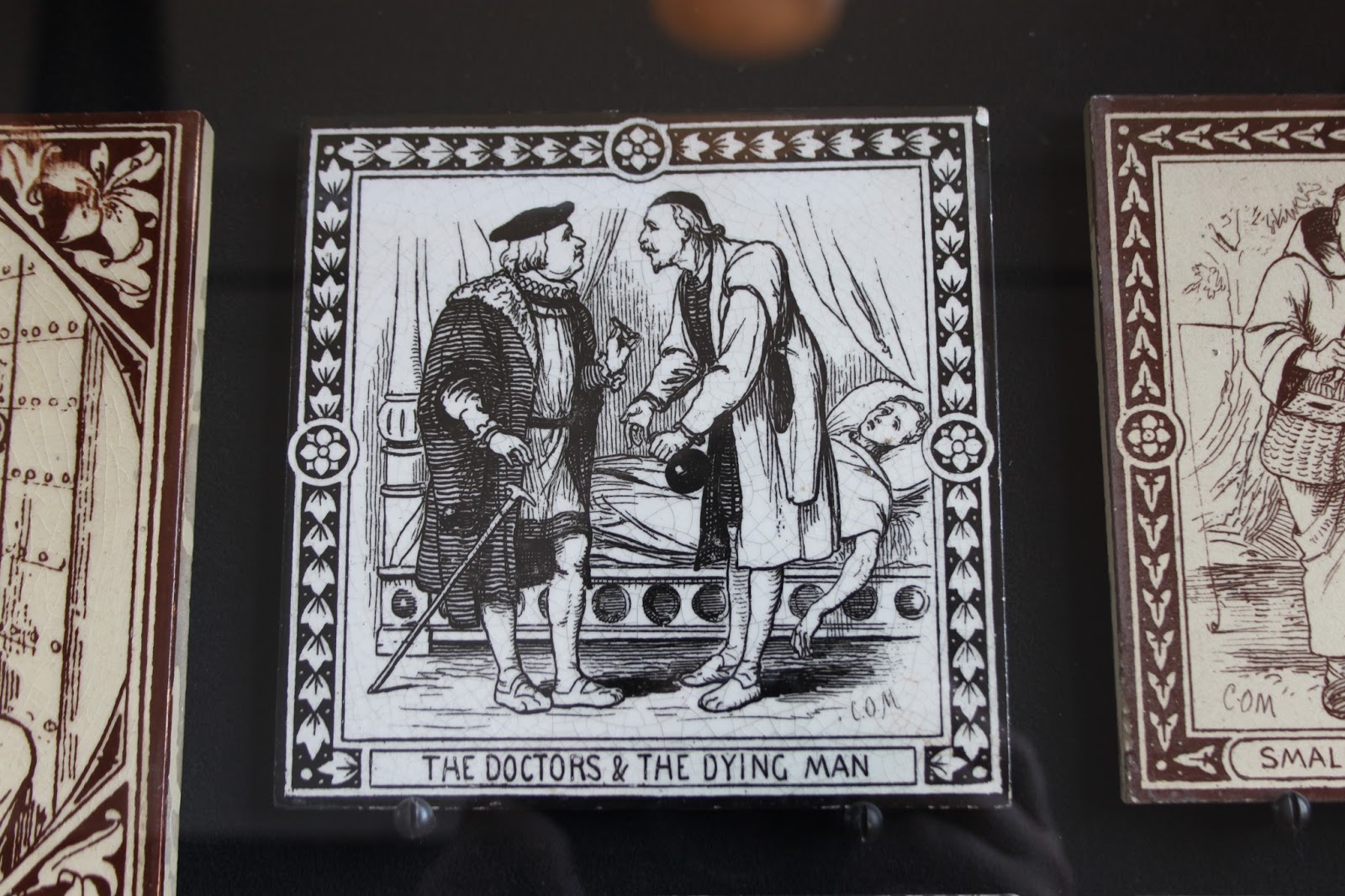
We didn't get around to taking pictures at FatE, so to conclude, here are some 19th century tiles depicting folk tales which can be found in the museum at Jackfield...



Subscribe to:
Posts (Atom)