Tiles and Tales

We're just returned from a few days away in Shropshire, where we were able to explore many of the beautiful medieval churches of the county.  There are many more parish churches than you might imagine and, unusually these days, many of them are always open to the public. 
 
One of the most striking details of these churches are the pavement of medieval tiles.  Perhaps it's an accident of survival, or perhaps this type of decoration took hold well in this area, but Shropshire certainly seems to have more than its fair share of two-colour tiled floors. 
 
In St Bartholomew's Church, Benthall
 
On the wall of the porch of St Giles' Church, Barrow
 
Beside the Norman font in All Saints Church, Claverley
 
In St James' Church, Shipton
 
At the Jackfield Tile Museum there were loads of Victorian tiles which had taken inspiration from their medieval predecessors...


But the real reason for heading to Shropshire was to go to the wonderful Festival at the Edge.  As well as being the best organised and friendliest festival going, they also have some of the very best performers.  We enjoyed some of the world's greatest tale tellers who shared stories to make you think, laugh, cry, shiver and then laugh much more.  It really is an amazing experience.  Well worth making a diary date for next year's one, (15th-17th July 2016), which will be the 25th and so is going to be an extra special celebration.
 
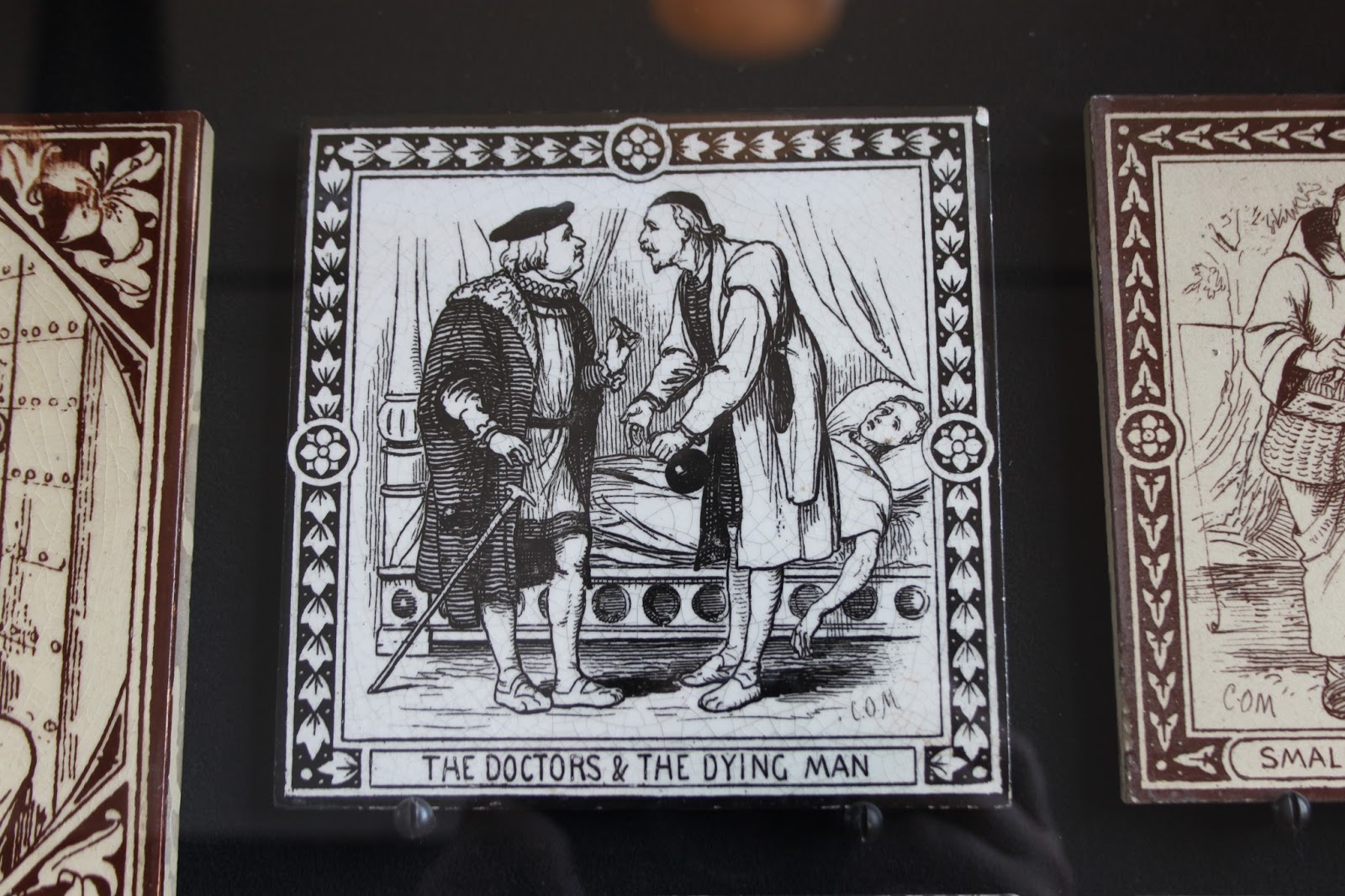
We didn't get around to taking pictures at FatE, so to conclude, here are some 19th century tiles depicting folk tales which can be found in the museum at Jackfield...


Approaching the Minstrels' Court

It's not long until this year's Minstrels' Court event, which will be held on Saturday 27th June.  As always it takes place in St John's Church, Chester, next to the amphitheatre ruins.  It is one of only a couple of re-enactment or living history events that takes place in its original and authentic location.


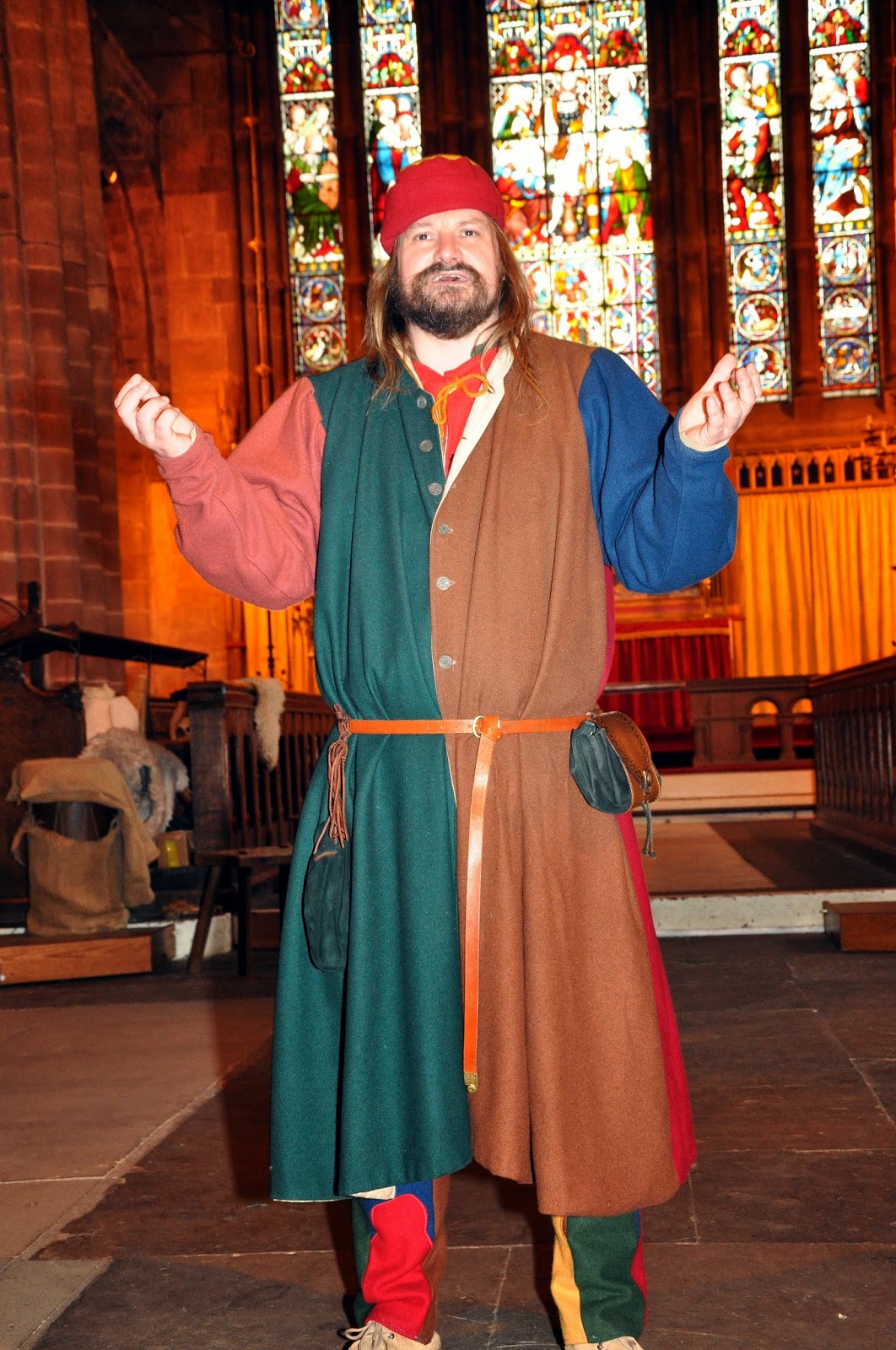
For those who haven't come across the event before, it's the recreation of the annual gathering of all minstrels in Cheshire, which had taken place in the city each midsummer from 1204 to 1756. Entertainers would obtain their licence to perform, without which they risked arrest.  The tradition began when the minstrels helped to save the Earl of Chester from the castle where he was besieged by the Welsh.  You can read more about it elsewhere on this blog.

We're so pleased to have the ongoing support of dozens of musicians, who kindly give up their time to be part of this event.  There will be some of the country's top historical musicians performing through the day in the church, with more informal music sessions in the large porch and outside too.


Around the church there will be fascinating living history displays, recreating some of the bustling scenes which were always part of life in St John's in medieval times.  Far from a place of quiet prayer, the church had business dealings and legal contracts made within its walls.  So if you're visiting the Minstrels' Court, expect to meet scribes, weavers, pilgrims, traders and even soldiers.


In the chancel of the church there will be performances of medieval and Renaissance music, along with legends and folk tales from storytellers, a medieval puppet show and even the demonstration of the arming of a knight.


At 1pm the gathered minstrels leave the church to process through the city's busy streets, causing quite a stir with playing and dancing.  At around 1.30pm they arrive back at St John's to gain their licences in a recreation of the original ceremony.  This is one of the most atmospheric moments of the day.  And then it's back to more music and living history.


The daytime event runs from 10.30am-5pm, everyone is welcome and it's free.

In the evening there is a special concert in the church, starting at 7.30pm and featuring Piva, one of world's best Renaissance bands.  Tickets are just £5 on the door.  Well worth catching their fantastic music in this amazing setting.


Hopefully we'll see some of you at the Minstrels' Court for the usual mayhem and merriment!


Exploring in Exeter

Back at the start of May we were down in Devon and took a chance to explore Exeter Cathedral, a place we'd wanted to see for quite some time.  It was a fascinating place, with much more variety of curiosities and hidden details to discover than in most of Britain's cathedrals.
 
For this post, we'll go sparingly with the words and allow the pictures to tell the tale.
 
The 'Minstrels Gallery' second from left is a bagpiper.  The cathedral didn't know what the sixth from left is playing but my guess, (from far beneath), is that it's a jew's harp.
 
One of very many canopied tombs with effigies.
 
Some roof bosses in the chapel of St John the Baptist.  St John is in the centre, in long hair and rags.
 
St Laurence being roasted on the grid iron.
 
There just had to be a green man...
 
15th century painted panels with the Annunciation.
 
Another bagpiper, this time on a canopied tomb.
 
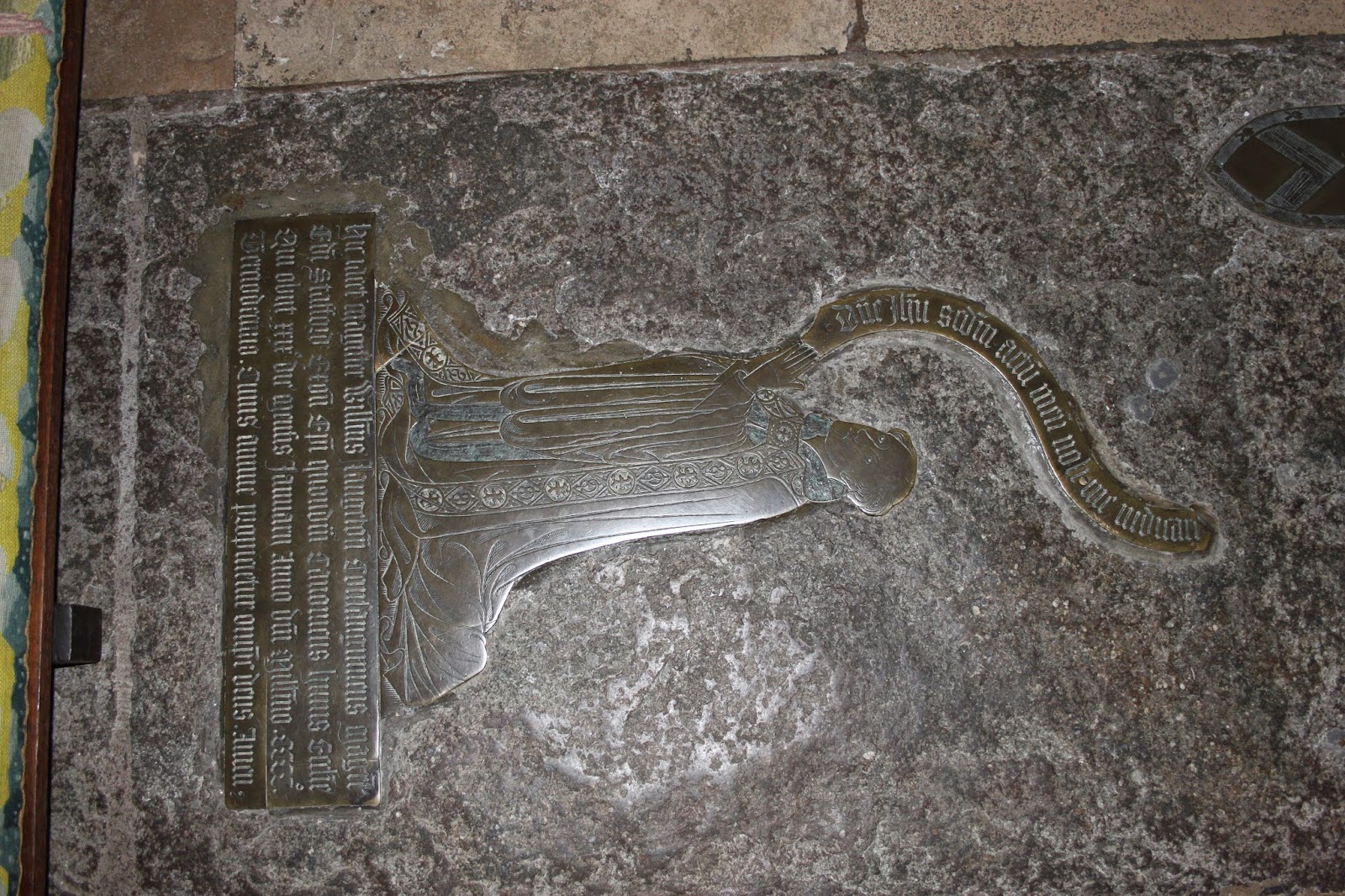
Memorial Brass


The tomb of Bishop Edmund Lacey, this was the closest Exeter got to a shrine for pilgrims.   The cathedral was damaged in an air raid in 1942.  When the damage was cleared up, several votive wax offerings from pilgrims were found.  These are the only examples known in Britain.
 
20th century replicas of medieval tiles.
 
And some relaid medieval tiles.
 
Misericord of an elephant, one of the most realistic medieval depictions I've seen.
 
And another elephant, this one a Victorian bench end in the quire.
 
Medieval misericord with pipe and tabor player.
 
Curious detail of a cherub blowing bubbles above a tomb.
 
St Apollonia, patron saint of dentists, with her tooth pulling pliers.
 
Medieval wall painting of the Blessed Virgin alongside the entrance to the Lady Chapel.
 
The stone allows crisp, deep detailing.  You wouldn't get this with Cheshire sandstone!
 
An anonymous cadaver.
 
A striking word at eye-level on a memorial plaque.
 
Shepherds at the nativity, one with a recorder.
 
The original clock movement for the cathedral.
 
Door to a tower with hole for cathedral cat.  The cat was paid a penny a week for his duties in catching mice.


There was even more to see, so you'll have to make a trip to discover the rest for yourself.


Gerard’s Herbal at TobyFest, Powderham Castle


Hilda Leyel, founder of the Herb Society
You may recently have read our post about John Gerard’s Herbal.  We were really fortunate to have an original copy in our care to display at the Toby Buckland Garden Festival in early May.  Dating from 1636, it belongs to the Herb Society  and is shortly to be loaned to the Garden Museum in London for their new displays.  It came to the Society through the library of Hilda Leyel, its founder. 
Toby Buckland, President of the Herb Society
Toby Buckland is the new president of the Herb Society and he was keen to show the Herbal and to talk about some of the fascinating facts Gerard records.  Gerard not only spoke about the herbs native to this country, but also plants collected abroad.  He refers to the aubergine as about the size of a goose egg, in fact the original aubergines were smaller than today’s and white.  This is said to be where we get the alternative name of ‘eggplant’ from.  Gerard stated that tomatoes were eaten in Spain and Italy, but that they were in fact bad for you and ‘rank and stinking’.  This may be because they were originally linked to the mandrake from the nightshade family and therefore thought to be poisonous.
Gerard's Herbal
We had the Herbal open on the page about pennyroyal, where we also had both the dried and fresh plant.  Pennyroyal is from the mint family and would have been put between the pages of a book to stop insects from eating the ink.  The fresh herb today can be used for rubbing around areas where you have an ant problem to deter the little blighters from entering.  On a more sinister note, pennyroyal, also known as pudding grass, was long known as an herb which would bring about abortions.
The Herb Society stand interpreted the different uses of herbs as described in Gerard; for medicine, strewing, cooking and for dyes.  There were also a range of Tudor medical instruments to illustrate Gerard’s role as Master of the Barber Surgeons.  There was a display and stand about the Herb Society as we were encouraging people to find out more and join up.  Our stand was in the setting of the library of Powderham Castle which Tom loved as there were a couple of secret doors, just like in Scooby-Doo!  I also got to chat about this fantastic Herbal with Lord Courtenay, the son of the 18th Earl of Devon, surrounded by his family's library! 

The next event we are working on for the Herb Society is our stand at the Tatton Flower Show 22-26 July 2015 on the theme of ‘Thyme for Tea’ focused on herbal infusions.  Hope to see you there!!