To a Haggis

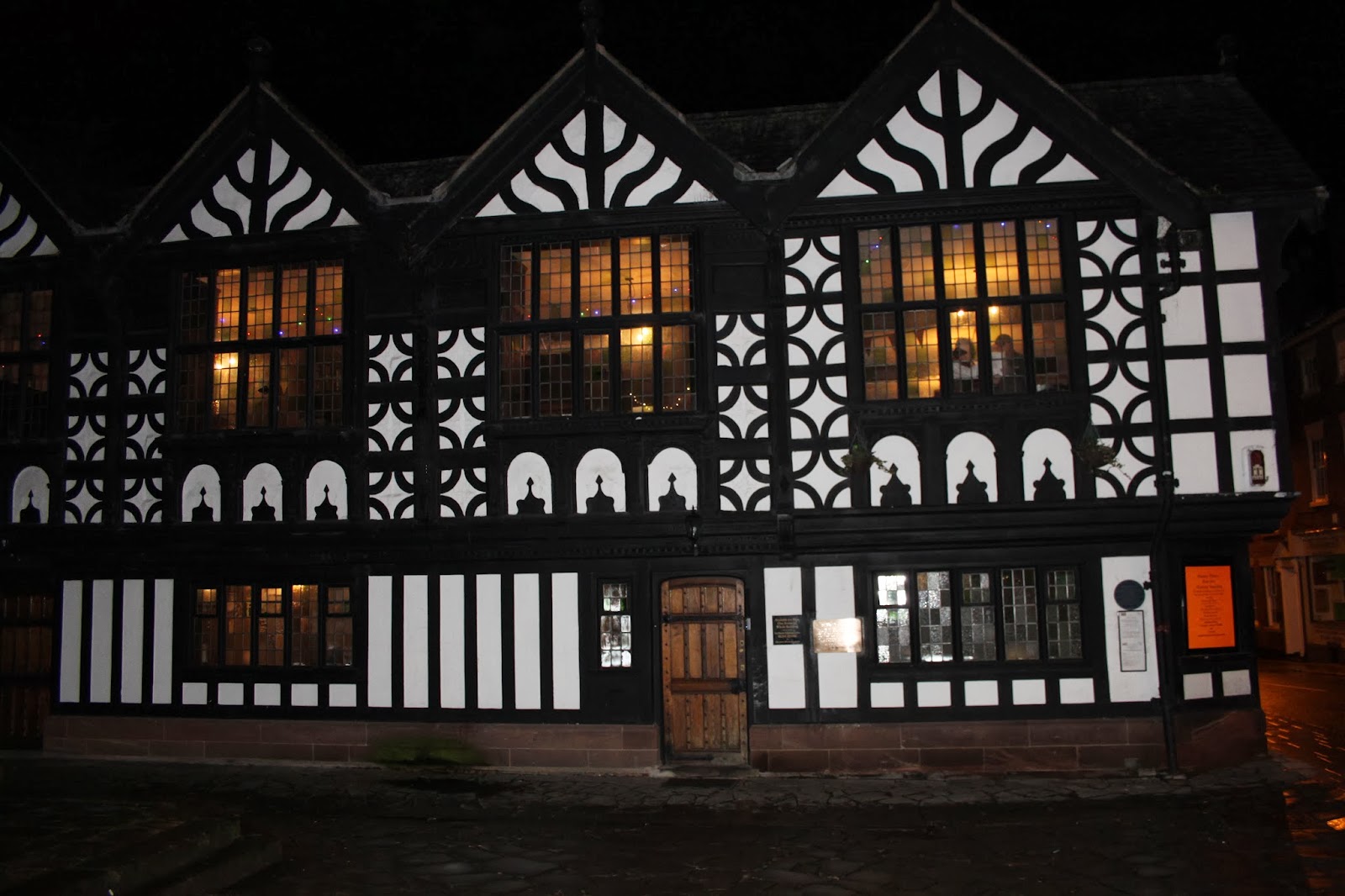
Yesterday it was Burns Night, when we are normally invited to share the evening with a gathering at a friend's house, but last year our little group decided to make the event a bit more special and so hired out the lovely Stanley Palace in Chester.  There had been a lot of planning going on to make it extra special this time.
Guests were bringing plates of food to share and so Sue was on duty arranging all of this...
Haggis, neeps and tatties were being prepared in the kitchen beside the beer... 

Fairy lights and tartan bunting were arranged throughout the building and it was nearly time to begin welcoming all the guests...

I regularly tell people that not all bagpipes are Scottish, but for this event I did dress the pipes up a bit...
At 8 o'clock the haggis was piped through the building...

We played the tune for a Burns' song 'A man's a man for a'that'.
Of course we had the 'Address To A Haggis'...
Then, as is now a tradition at our Burns Night celebrations in Chester, there was a little extra play on the story of the haggis.  This year it was a tale of how the haggis was once a widespread dish across Britain and how it came to be just a Scottish favourite.  It was a tale of medieval mystery, of secret societies, the gastronomic occult, exiled Italian abbots running coffee shops, archaeological discoveries and the revelation that the true origins of the haggis had been disguised in the words of a mummers' play.  Whether the gathering believed all of this, I'm not too sure...
The newly rediscovered play was enacted for the first occasion in modern times; Here's Haggis and Trencher...
And then Bread and Tripe ready to pounce with the knife...
Then it was time to judge the best dressed tankard competition... 
Followed by a Burns' song 'The Winter it is Past'...
 
And then it was off to eat, share stories, catch up with friends, play music and dance for the rest of the night.  The camera was put away then so you'll have to imagine all that.
 
Maybe it wasn't the most 'authentic' Burns supper, but the mood of sharing an evening with friends, music and song felt like an appropriate way to celebrate the event.

What's in the Well?

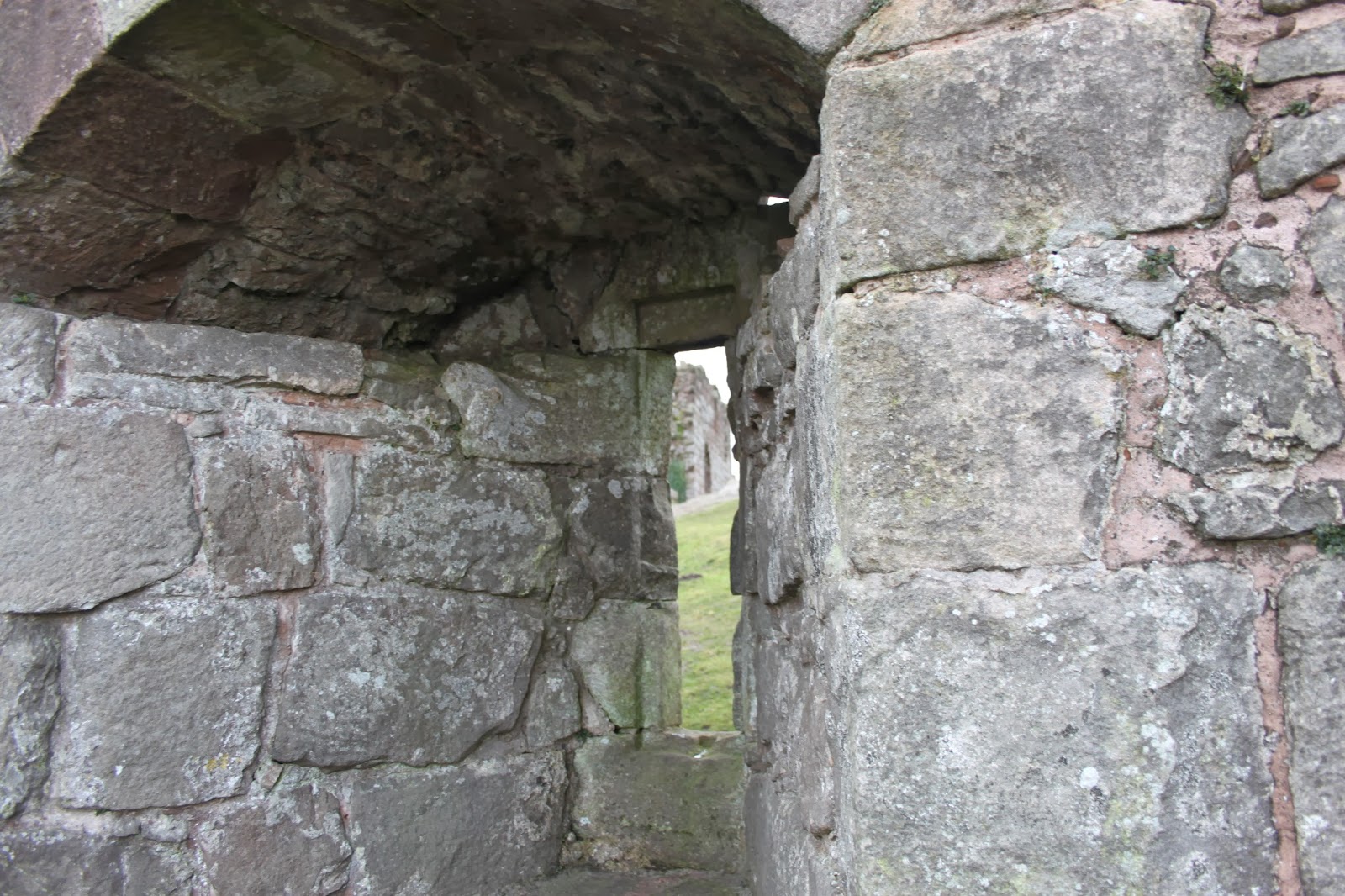
Recently we returned to Beeston Castle, to climb the crag and look out over the Cheshire plain.  The moles had been busy and we stopped regularly on the walk up to examine the miniature spoil heaps of their excavations for any traces of archaeology and were rewarded with a few sherds of 17th century slipware and blackware.  But it was also a trip to return to the well inside the inner bailey at the top.


The view from the top.  The white dot just about visible in the middle is the Lovell Radio Telescope at Jodrell Bank
There had been a hillfort at Beeston in the Iron Age but in the 1220s a castle was begun on the crag by Ranulf de Blundeville, the same Earl of Chester who, some will recall, had been saved from a siege by the musitioners of Chester and whereby the tradition of the Minstrels' Court began

Inside the inner bailey is a well, just as you expect to find in a castle.  But, with the location of the castle atop this rock, it is very deep, the deepest in Cheshire and one of the deepest castle wells in England.  It is supposed to reach down 365 feet which, being the same number of feet deep as days in a year, seems to have been picked to give the well more of a mythic quality.  And it does have a legend associated with it...

In 1399, King Richard II who was much beloved in Cheshire, though not well supported in the rest of his kingdom, travelled from Chester to Ireland in an attempt to reassert his authority there.  Before leaving he hid his Royal treasure at the bottom of the well at Beeston.  When Richard returned from Ireland via Wales he met with a challenge to the throne from his cousin Henry Bolingbroke and was imprisoned, deposed and eventually starved to death at Pontefract Castle, (he presumably didn't find the stash of liquorice there).  But the treasure was left unclaimed at the bottom of Beeston Castle well and some say it is still there, guarded by a demon.

Richard II, accompanied by his bodyguard of Cheshire Archers, riding through Chester's Water Gate en route to Ireland
Now, this is where I come into the story.  Eight years ago, my brother and I went out for a walk on a winter's day and stopped at the Dysart Arms at Bunbury for lunch, though it's important to note that I didn't have a drink.  We then went up to the castle, where we were the only visitors.  At the well we decided to drop in a coin to see how deep it was.  After a long pause, it is a deep well, we heard "grrr".  So, of course we had to do it again.  Another pause, then "Grrrrr!".  Then once again, and this would be the last time because after that I'd only pound coins left, "GGGRRRRR!". 

We made our way back down the hill faster than we might otherwise have done, and looking back behind us a fair few times.  Although we made light of it, saying it was probably an angry badger at the bottom, it was a little unsettling at the time.  Now, it was most likely the distorted echo of the coin falling to the bottom, and our ears getting attuned to it so it seemed to grow louder, but I can certainly see how this could seem like there is a demon in the well.  And if enough people have done what I did, there certainly will be a great treasure at the bottom of the well.

Oh, Apple Tree We Wassail Thee


Yesterday we headed off to Stretton Watermill for the apple tree wassailing.  Apple trees are very important to mills, their wood being used as the teeth of gear wheels in the machinery, strong enough not to be worn down by constant meshing with other gears, yet brittle enough to shear off in an accident and save the rest of the wheel.  The apples themselves would also be enjoyed as food and as cider.

It was a clear and mild winter's day as we drove through along to the mill, the bare trees allowing a clear view of the whole Sandstone Ridge and the low winter sun making Beeston Castle glimmer brightly.  The watermill itself is near the border with Wales, these marches being the traditional home of apple tree wassailing.

 
We set up as the light was dwindling and lanterns were lit to provide a warming glow.
 
 
Spiced cider was mulled and shared.  We used four gallons of it, the preparation was quite a task in itself, but well worth it.
 

Friends began to gather and the wassailing began with the telling of the tale of the Apple Tree Man.


Then the group collected rattles, timbrels and drums and set off in procession around the trees making noise to drive away evil spirits.


Toast was hung in the branches for the birds.


Then the procession returned back to the oldest most ancient apple tree.  'Young Ball' the horse from Jones' Ale Soul Cakers accompanying the procession.


A many handled wassail cup was shared around.


We sang the Apple Tree Wassail to the oldest tree.


Cider was poured upon the roots.

 
A gun was fired through the branches to drive away the witches...


Then it was done, and we headed off to the Carden Arms to share some tunes together.


The apple tree wassail at Stretton Mill is certainly a mixture of various winter traditions, but it's becoming established now and has its own character.  They certainly are very important, whether we're encouraging the sun to return after winter or crops to grow, or more simply a chance to bring people together for some merriment in a harsh cold season and the maintenance of good fellowship.
 
 
Many thanks to Paul Quigley for some of these pictures.

Pipe Music from Underground

About seven years ago, around the same time I got hooked into bagpipes and their music, I was preparing an exhibition looking at Cheshire writers and the links to the landscape.  It was at that time that I first met Alan Garner and began to explore the many tangents in his work which reflect the land, folklore and legend of the area.
 
Though I personally enjoy his later works far more, Garner is perhaps best known for his first book published back in 1960.  Entitled The Weirdstone of Brisingamen, it develops the legend of Alderley, with its account of sleeping knights and great treasure under the hill and the ensuing action plays out across real landscapes of woods, cliffs and mines of Alderley Edge in Cheshire.  You can still go there any day and see families and walkers wandering around and looking for features from Garner's books as well as the myriad other legends on the Edge.  Even on a busy day it still has an otherworldly feel and it is easy to see why so many curiosities and folk tales have emerged there over the centuries.
 
A couple of years ago I came across a reference which connected my interests in legend as well as bagpipes.  I've written about this elsewhere before, but not on this blog, so I felt it was about time I did so.  And if it provokes some to explore the Edge, then so much the better.  I feel it is at its best in winter.

In 1843, Elizabeth Stanley, of the family of local landowners, wrote in Alderley Edge and its Neighbourhood, “The people living on the Edge persuade themselves that they hear music under the ground”. I’d been aware of this already, and also that Alan Garner’s cousin Eric had described hearing music underground on the Edge when he was a boy. But looking into it further I was intrigued to hear a recording of him describing what he actually heard.

At the age of 7, which would make this event in 1941, Eric Garner had been playing with two friends on the Edge, when they stopped to rest at the place called Stormy Point. He remembers it being a dull, murky, drizzly winter’s day. There they heard music underground, moving in a line beneath them at Stormy Point. They were terrified and ran home.

This much I had heard before, but what I hadn’t realised was that Eric had described the music as “a set of bagpipes started wailing, on Stormy Point”. Suddenly I was greatly intrigued. If you were going to imagine, or create a story about ethereal music from underground where sleeping knights await the day to rise and save England, then surely you would suggest heavenly singing, or a harp? But bagpipes..?

I then tried to think about what the sound would be that he was describing. Being a 7-year-old boy in Cheshire, in 1941, I doubted he’d come across anything other than the Great Highland Bagpipes, so assume that was the sort of sound he heard. Eric had described “wailing” and presumably this resembled a reedy noise, along with some kind of a droning.

If we exclude the very unlikely chance of a Highland piper having a practice in the cramped tunnels in the rock under Stormy Point at that moment, we could perhaps consider the possibility that the sound was created by the passage of air through those very tunnels and disused mines. Maybe, under certain climatic conditions causing the air pressure in the tunnels to change could create a bagpipe like sound?

As far as I can tell, no-one else living today has heard this sound. According to Alan Garner, his cousin Eric has lived very close to this spot all his life and walks to Stormy Point almost every day, but has never heard the same music since. Music from underground had been heard more regularly there in the 19th century, but then there was far less tree cover on the Edge which may have allowed the air pressures above and below ground to change more regularly – I don’t know, I’m not technically minded like that.

But I tried a quick internet search anyway, and whilst I found no more mention of bagpipes underground at Alderley, I did come across another intriguing clue. In 1980, some local geologists were trying to find the location of some lost mine workings in Mottram St Andrew, near Alderley Edge, where the rare vanadium mineral “Mottramite” had been recorded in 1876. They had drawn a blank, until one night in the pub they overheard a local woodsman talking about how, in certain weather conditions, he heard bagpipes playing in his garden. The geologists went to investigate and duly found the shaft of the mine.

So, to me at least, it does seem likely that with certain atmospheric conditions, disused mine workings can produce a sound suggestive of bagpipes. It also reminds me of the folktales from around Scotland of pipers descending into a tunnel and playing as they progress along so their companions above ground can follow the track of the tunnels – at some point the pipes go silent and the piper is never seen again. This particular legend is not found at Alderley, though the landscape is rich in other folktales.  There are many legends from across Britain of pipers disappearing into fairy hills to play for the little people, occasionally re-appearing many years after they were last seen by friends, though to the piper only a couple of hours have passed.  Many of the locations of these "fairy hills" are today identified as Bronze Age burial mounds, and there are many such burial mounds around the Edge, including one right next to the very spot where the bagpipes were heard underground.

Earlier this year, on International Bagpipe Day, a group of pipers from across Cheshire walked out to Stormy Point on the Edge, to the spot where the bagpipes were heard underground so we could play some tunes to celebrate the connection between this place of mystery and our instrument.  It was very cold indeed with gusts blowing our drones in all directions and we withstood this for twenty minutes or so before piping our way back to the warmth of the Wizard Inn, but feeling we had reunited music with legend.

Signs from Shrines

I recently spoke to the very friendly bunch at the Crewe and Nantwich Metal Detecting Society on the theme of Pilgrimage in Medieval England.  From time to time their members come across tiny artefacts with clues about pilgrims and their travels.

These little pewter badges, or signs as they were called in the period, are some of my favourite artefacts from medieval times .  They combine in one small space themes of piety and devotion to Christ and the saints as well as folk belief.  The craftsmanship of these items was often of a very high standard and details were sometimes closely detailed and frequently showed vitality in movement.

These signs were sold at shrines so pilgrims could return home with a memento of their travels, a journey which would often have made an enormous impact on their life, as well as bringing an element of the saint's holiness with them. 

In Cheshire there is evidence of pilgrim souvenirs from the early Christian period, ampullae or holy water flasks brought from the shrine of St Menas in Egypt and dating to the 6th century AD.  These pottery finds have been found across Europe, but rare in Britain, though there are two finds in Cheshire, close to the Mersey, showing the importance of the river as a trade route.  One was found at Meols at the northern end of the Wirral (the artefact is now in the collections of the Grosvenor Museum) and another discovered at Runcorn (now in the collections of Norton Priory).  Though the image is rather worn it depicts St Menas standing betwixt two camels.

Signs became more popular in the later medieval period with the increase in pilgrim travel to the Holy Land.  Some of the earlier souvenirs were simple, such as palm leaves for Jerusalem in memory of Christ's triumphal entry into the city, an emblem which remained popular for centuries and indeed giving rise to the name, (and subsequently the surname), Palmer, which denoted someone who had been to Jerusalem on pilgrimage.  More naïve pilgrims to the Holy Land might also be sold some of the clay from which God made Adam, or a bottle containing air which had been breathed by Jesus.

Pilgrims would often want to take away parts of the shrines as souvenirs, breaking off parts of the structure or scraping away at the stone and taking away the dust.  Naturally, the feretrars, those monks in charge of the shrines, did not wish the shrines to be so defaced and a solution developed in producing pilgrim signs which could be sold at official mementoes and thereby protect the shrine as well as satisfying the pilgrim's desire for a souvenir.  These signs could also be blessed and even touched to the shrine in the hope they might absorb some of its sanctity.

In 1492 a plumber in the city of Chester agreed to make a mould depicting an image of St John, presumably for pilgrims attending the nearby church of St John the Baptist.  Maybe his experiences in working with lead gave him the skills necessary to produce a mould for the pewter pilgrim signs.  Pewter, an alloy of lead and tin would give a shiny silver-like appearance.  Lead was very rarely used for these badges, but was commonly used for the ampullae, those holy water flasks, as the pewter's granular structure would crumble if crimped shut, whilst lead could be bent and allow the holy water to be kept inside.

Ampullae in the form of scallop shells, the symbol of St James the Greater, whose shrine was at Compostela in Northern Spain, have been found in a few locations in Cheshire, including the example shown here, discovered near Davenham, and another from a field below the Church of St Mary and All Saints, Great Budworth.  It seems that the pictured example was accidentally lost as one of the loops for hanging this around the pilgrim's neck has snapped.

However in the example below from Nantwich it seems that this has been deliberately deposited, as the loops are still intact but the top of the flask had been snapped off to allow the water to escape.  Ampullae were sometimes deposited in fields to bless the crops, or also to bless or protect a water source.  This particular example was found in a field with three springs.  In a similar fashion, pilgrim signs might also be fastened to barns or stable doors to protect livestock, elements of an ancient folk custom being carried out in parallel with devotions to the established church.
This example was brought back to Cheshire from the shrine of Thomas Becket at Canterbury, one of the most popular in medieval England.  To date it is the only ampulla from St Thomas' shrine discovered in this particular form, though there are dozens of holy water flasks from Canterbury in other forms and this particular design is also well know as a flat badge.  The top of the ampulla would have come to a point as it is Becket's mitre, but had been snapped open to allow the water to escape.

Naturally, as a Cestrian, one of my favourite of all signs has to be that depicting one of the miracles of St Werburgh, patron saint of Chester.  The badge shows the penning in of the wild geese, whereby Werburgh averted a famine.  Later elaboration of the story had Werburgh restoring to life one of these geese which had been killed by a servant of hers. 

Here's the story from a mid-14th century misericord in the quire of the Abbey of St Werburgh (today's Chester Cathedral).

And here it is as a replica of one of the pilgrim signs, this example having been made by Colin Torode of Lionheart Replicas.

The discoveries of original St Werburgh signs show just how far some of the pilgrims had travelled.  Two have been found in Salisbury, Wiltshire, and another on the Thames foreshore in Southwark.  None have so far been found in Cheshire, but we might perhaps expect them more usually to be bought and taken away further from the place of manufacture.  Maybe one day a mould might be found in Chester...

When these pilgrim signs are discovered they cause us to reflect on the piety, devotion and bravery of our ancestors, who set off to places unknown to them, often with no more equipment than a bag and a staff, and certainly without maps or insurance.  I wonder how many of us might be able to do that today?
 

In Comes I That Never Came Yet...

It's getting close to the time of year for soul caking in Cheshire.  The swift passing of the seasons and the sudden arrival of the autumn's tradition never fails to surprise us, but I'm glad it's here again.  I've been doing the play for 19 years now, which means that for as much as it is about keeping a tradition alive, it's also great to have the occasion to bring together friends that we only see at this time.
Helsby Soul Cakers, circa 1920
We always get asked what it's all about, and there isn't a straightforward answer.  When I first started performing in the plays, I was a keen archaeology student and did a lot of reading around wanting to know more about the tradition.  The books then were full of writings about the plays being an enactment of a pre-Christian ritual, the triumph of spring over winter, the death of the old year and birth of the new.  Sounds great, but even then I knew that wasn't quite right.  These days, there are thankfully many more considered works and much detailed study has taken place, it's essentially a seasonal folk play of a form that seems to stretch back to the mid-18th century, (If you're so inclined to read more you could begin with the website of the Traditional Drama Research Group.)  But my short answer when I'm asked in the pub after a performance is that it's an old Cheshire tradition and a bit of a spectacle so that the performers can do a collection at the end. 
Soul caking is one of those seasonal mummers' plays where a hero, St George in our case, challenges his enemies to a fight and slays one of them who is then revived by a quack doctor before a host of odd characters appear and collect money from the audience.  The plays are fairly widespread across England and crop up in some parts of Wales and Scotland too being performed at different times of the year in different regions.  The Cheshire versions, with the exception of Alderley, are performed around All Souls' Day, 2nd November and from that they derive their name.  In earlier times the performers would receive a soul cake, a spiced bun, in memory of those that had died in the past year.  These days we collect money for charities instead, and whilst sometimes soul cakes are presented we more usually receive a round of drinks instead from the landlords in the pubs we perform in.
A particular element of the Cheshire version of these plays is the presence of a wild horse character, a cloaked figure with a horse skull and there are stories of a tradition that if a gang of soulers didn't have the horse skull with them they couldn't collect, so rival gangs would try to steal each other's horse.  Thankfully we've managed to keep hold of our horse, Young Ball, all the time I've been with the group.

Our lot are called Jones' Ale Soul Cakers as they emerged from Jones' Ale Folk Club more than forty years ago.  Some of us, myself included, inherited the roles from our dads or fathers-in-law, others have been roped in after they showed passing interest at the end of a performance.  There's about eight characters in the play, but on occasion it has been tricky to get everyone along to each performance, so I know it can be done with four people and some speedy costume changes.  We'll have a full ensemble this year, but as I type I've no idea who I'll end up being, I've done all the parts over the years. 
The first generation of Jones' Ale Soul Cakers
If you want to catch us we'll be out and about on Friday 1st November around Lower Bridge Street area of Chester and over the river in Handbridge on Saturday 2nd November.  The timings and those for the other groups going out and about usually get listed on the Master Mummers website.  One of them, Antrobus Soulcakers, are supposed to be the folk play group with the longest unbroken tradition in Britain.  They perform not too far from us, but I've never yet seen them, though I hope to one day.  Then again I say that each year, and our failure to catch them is becoming a tradition in itself.