Christmas in the Apprentice House

We returned to the Apprentice House at Quarry Bank Mill to help celebrate a Victorian Christmas. 

This is a lovely event to be a part of, as it really feels like you are in the past, with little details everywhere.


There is no electric lighting in the house, just candles and the glow from coal fires, with little daylight at this time of year, but somehow this all adds to the atmosphere.

The stone flagged floor is cold though.  Sue wisely wore clogs, but I could feel the cold seeping up through my leather soled shoes.  At least there wasn't ice on the inside of the windows like we had last year.

Visitors make their way in to the house past the vegetable patch and wash-house,

through the apprentices' school room and dormitories,

past the Doctor's treatment room,

and down into the parlour where I was telling Victorian winter tales and ghost stories for Christmas, with intervals of piping.  For much of the day the room was packed full of people listening to tales of the Apple Tree Man, the Hobyahs, Samuel and the Worm, and the Cow that Ate the Piper.

Then our visitors made their way into the kitchen where Sue was preparing a Christmas pudding as well as letting visitors make their own spice bag for mulled wine.

We heard from the hundreds of visitors that the carols, decorations and jolly Father Christmas up at t'mill building were very good too.  We're back there next Sunday (16th December 2012) to do the whole thing again.  Why not come to join us?

Yuletide begins...

The lead up to Christmas is a busy time for us, with Tudor Yuletide workshops for schools each day now, interspersed with Victorian Christmas events at various historic places, talks on seasonal traditions for local history groups, a couple of craft fairs, lots of concerts that we're in, or watching friends play at - it's a wonderful time of year if you're into Early or traditional music.

Yesterday we went to the famous Ludlow Medieval Christmas Fayre with our friends, Chris and Joan from FayrePlay, but we were all just on a trip out, not getting medieval ourselves.  It was freezing cold as is traditional for a Ludlow Christmas Fayre and there were some great musicians and storytellers too.  We didn't spend much on the craft stalls though.

Today we went to the Christmas Fair at Norton Priory.  We've been along to this with our medieval displays for a number of years now, and it gets better every time.  This year we were in the museum area rather than squashing up in a crowded undercroft as before.  We had displays of medieval musical instruments, though I confess to getting a little tired of playing period Christmas tunes so made the odd venture into later eras and tunes which were not at all festive.  No one seemed to mind.

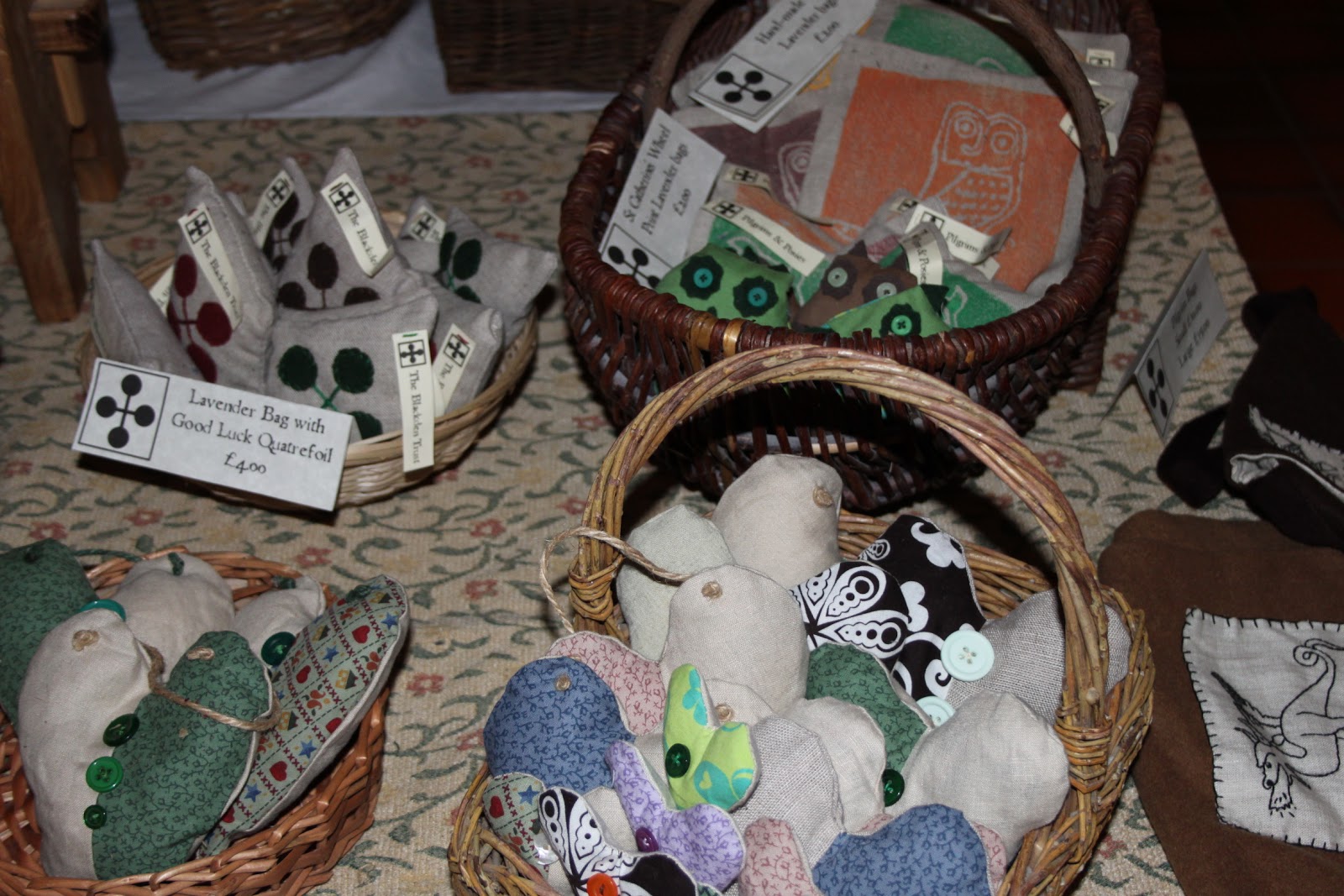
Sue had been busy for weeks stitching an enormous range of festive goodies which we also had on our stall, along with some of our medieval replicas, Cheshire folk tales books and little bagpipers which I'd made.  We did a very good trade indeed!


We also let people try making their own spice bag to prepare hipocras, a medieval mulled wine, which was a very popular activity.  There's nothing like cinnamon, ginger, nutmegs and cloves to evoke the essence of Christmas, though we also added long pepper and grains of paradise to follow an old recipe.

Alongside us was Tony Saxon with his beautiful replicas of historic bracelets and pins along with his chainmail jewellery and displays of armour and arrows.

And Norton Priory had their display of traditional skills, concentrating mainly on beekeeping in this instance.  I was very much taken by their replica Tudor beekeepers costume based on Bruegel's picture, which we've now hatched plans to recreate for a photo.


The medieval undercroft was packed with a wonderful farmers' market and lots of beautiful crafts too.  We managed to get lots of Christmas presents very quickly.  It's rare these days to find a real craft fair where people have made the goods themselves, and can fascinate you with the history and background of their craft, but you got that at Norton Priory.  The only problem perhaps was that no-one seemed to be charging anywhere near enough for their efforts.


A micro-brewery was set up at Norton about a year ago, but despite us being there several times for their events, we hadn't yet got to try their Priory Ale, but rectified that today, and very good it was too!

So, as I type this, Sue is making yet more Christmas crafts for the other events we've got coming up, having sold more than we expected today.  And I have to check on some pies and pasties which I've got in the oven now ready to lay the table for a Tudor Yuletide tomorrow...

A Trip to Siddington at Harvest Time

For many years we've heard about the harvest decorations at the church at Siddington in Cheshire but this weekend was the first time we managed to get along to see them.  The church is 15th century and timber framed, but was clad in brick in the early 19th century as the walls began to bulge under the heavy stone roof.  Later, painted lines suggested the hidden timbers.

The church harvest decorations had deservedly drawn the crowds who were given a warm welcome.

But stepping inside was truly breathtaking.

The church was illuminated by corn dollies everywhere, over one thousand of them.

They are made by Raymond Rush, now 84 years old, who was still busy making more dollies in his workshop alongside the church during our visit. Usually the corn dollies are just regarded as a 'fertility symbol', an all-too-convenient tag given to traditions that some people just can't understand.  I'm yet to be convinced about any real origin for the making of corn dollies, though I do like the idea of them holding the 'spirit of the corn'.  Imagine the life of the wheat escaping the scythe until it reaches the last stand of corn, when this is cut you would know you have the spirit in that straw.  Making it into a dolly keeps it safe through the winter then it is broken with due ceremony on Plough Monday to release the spirit back into the soil to give life to the new year's crop.


Whatever the true origin, they are different between regions and have changed through time.  It seemed very fitting then to have corn dollies reflecting the Diamond Jubilee and Olympics this year.

The harvest decorations at Siddington are an amazing sight and I'm very glad we got to see them.  If you get the chance to visit, do take it.

A Pepys Pilgrimage

Aside from the living history, music and storytelling that we do with Pilgrims and Posies, I spend a good deal of time in character as Samuel Pepys, for school pupils exploring the Great Fire of London at Weaver Hall Museum.  Whilst I wouldn't quite call him my alter ego, I have developed quite an interest and affection for Mr Pepys. 

So, last week when Sue was attending a meeting at Kings College London about the forthcoming exhibition "Discover a Medieval City: Places, Voices, Journeys" and all the associated events that will be happening in Chester next year, I took the opportunity to go to London with her and trace some of the places associated with Sam and the Great Fire, a sort of pilgrimage for me, though not of my usual medieval style.

So I wandered from Covent Garden along Fleet Street and towards St Pauls, passing a couple of older buildings that had survived the Great Fire, and perhaps more miraculously later city developments.  Tucked away off Fleet Street was the location of Sam's birthplace and childhood home on Salisbury Court, there is a plaque but nobody seems to notice it.

Not so far away is St Bride's Church, where Sam was baptised, and would have attended services in his early years.  It was later destroyed in the Fire, rebuilt by Wren with the prototype of the wedding cake steeple, and destroyed once more in the Blitz.  The clear up of the latter devastation revealed earlier churches on the site and archaeology from Roman times to the 16th century which can be seen in the crypt. 

Then on past a great many more Wren churches and St Paul's itself.  Emblematic of the city it may be, but I've never liked his style, no character or emotion at all to my mind, especially considering what was there before.  The Great Fire may have swept away dirty cramped streets and crumbling churches, but with it lots of old tales and charm.

I paid a visit to the Museum of London, which has had several new galleries since I went a couple of years ago and very good they are too.  When you do so much work on a theme like the Great Fire, it is wonderful to see original buckets, helmets, firehooks etc, even when you've seen them many times before.  I resisted the urge to stop other visitors who were wandering by uninterested or dazed by the many thousands of treasures in the museum and tell them they should be looking at these.  The new gallery exploring the Blitz had some photographs and memories playing that just stopped me in my tracks.  These are tales, so horrific that only now are they starting to be told as those that lived through them approach the end of their time.  Yes, there was a blitz spirit, but there was also a much much darker side.  Go along to hear for yourself, I couldn't begin to do justice to the reminiscences.

Then I made my way over towards the seat of the Great Fire on Pudding Lane,


but chose not to climb the Monument on this occasion, I've done that a couple of years ago and got the certificate to prove it.

Not so very far away was Seething Lane, the site of the Navy Office buildings where Samuel Pepys lived during his diary years, though his home survived the Great Fire, it was destroyed in a smaller blaze some years later.  Today there is a small garden and a bronze of Mr Pepys and a nearby street has been named in his honour, I'm sure Sam would have been pleased and amused to see this.


Just nearby is St Olave's Hart Street where Sam and Elizabeth went to church regularly.  It was the first time I've been able to get inside for a look, and to see the beautiful monument Mr Pepys had made for his young wife Elizabeth, a vibrant image looking directly at the Navy Office pew where Sam would have been sitting each Sunday.  He was later buried under the communion altar, but didn't get his own monumental inscription until the publication of his diaries over a century and a half after his death.


So, the city is much changed since Samuel Pepys' time, but there is still a lot he would recognise and for me it was a chance to get better acquainted with both the place and the man.  Now, in two days time I will be donning the periwig once more for the first of thirty or so Great Fire of London workshops I'll be doing this autumn...