Ghost Stories

As the nights grow longer, it feels the perfect time to share creepy tales.  It's an odd thing that we find being unsettled so comforting.  But perhaps it's our ancient way of dealing with those troubling fears, whilst we're in company and then within a story which ends and we're safe.
Tom telling creepy tales from the past at the Water Tower, Chester
Through our historical work, spanning the ages from medieval to Victorian, we've come across many different approaches to the ghost story.  In medieval times they are often a vision of souls trapped in purgatory, urging their loved ones to make amends for some small demeanour they committed in life.  The spirits in these instances are not terrifying, but sad reminders of what people felt could happen if sins were not atoned for.  A moving tale from Hulme, near Haydock in south Lancashire, from 1373 tells how a man met a beautiful red-haired woman, fell in love with her and they lived together out of wedlock.  Some years later the woman died and was buried.  The man then saw her ghost, appearing exactly as in life, except with black hair.  She told her lover she was suffering in purgatory and that he should pluck hairs from her head and arrange a mass to be said for each hair he held.  The man took the hair and fixed them with a pin to his door frame.  He paid priests to say masses for her soul, and as they completed each mass he witnessed each hair turn back to the original red.  When they were all red, he knew his lover was in heaven.
 
After the Reformation these ideas of purgatory changed and with the religious tensions that continued right through the later 16th and into the 17th century, the ghost and spirits seem to become malevolent, bringers of ill-will, perhaps connected to witches.  In dealing with these threats, people used all sorts of apotropaia, protective devices such as "witch bottles", markings on doorways, holly bushes in hedgerows, and so on.  I'll write up some thoughts of these apotropaic objects in Cheshire at some point, there are many!  One of the more curious ghostly tales from our area involves a ghostly duck (!) which is trapped in a bottle by a priest, then walled up, all of which might have been inspired by the discovery of one of these witch bottles.
 
From those times and on into the 18th century we get the ghost stories we're more familiar with in folk tales.  In my native Cheshire ghosts were called boggarts, and for someone to be frightened we might have said they "took boggart", rather as we might say a horse was spooked today.  Some of my favourite stories from this time try to explain how such things are made, what they do and how they might be dealt with.
Tom emerging as a ghostly tale teller just before three sell-out performances at Port Sunlight on Halloween night.
Moving into the 19th century everything gets a bit more gothic and leave you thinking after the tale is done.  When most people think of ghost stories today, they tend to think of this era, and when I'm telling creepy tales I do find it makes things a lot easier to do it in Victorian gear.  These ghost stories are particularly well suited to Christmas and the depths of winter, so I'll be out telling tales in various historic buildings around that time, do come along if you like goosebumps and spinetingles.

On The Edge

Just a short post this one as I've written about this place several times in the past but wanted to share a few new pictures...
 
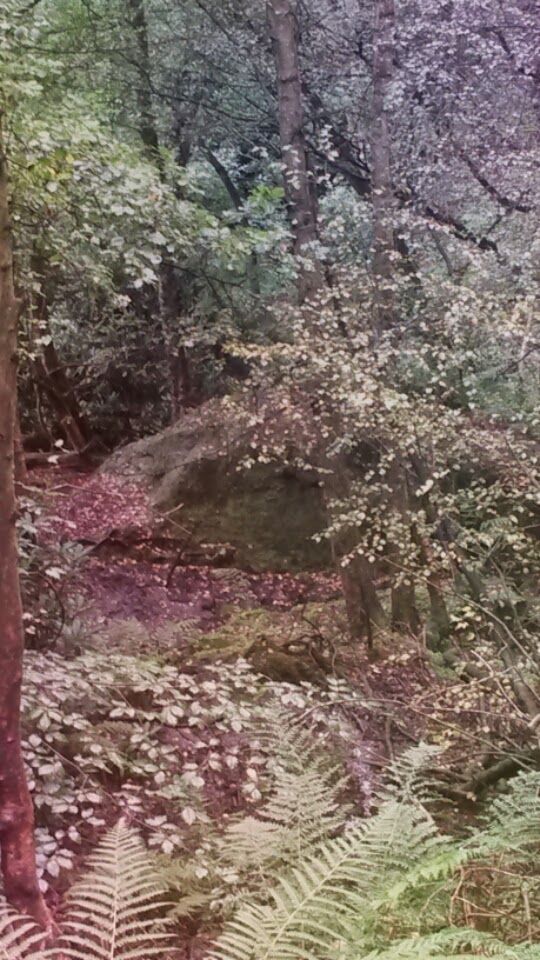
I hadn't been up to The Edge at Alderley for a couple of months so was happy to find an occasion to wander the woods there the other day.  I can't think of another place which has so many legends and stories associated with such a small area.  The setting has been the stimulus for tales since people started shaping the landscape there, way back in the Early Bronze Age.  You can't wander a few paces without stumbling across something to inspire a new tale, and I've a few more ideas myself now.


A Writer and his World

Over the past year I have been getting very close to the works of Robert Westall, one of the 20th century's most important writers for children and young adults.  He's a writer I first encountered as a 12-year-old, picking a book in the school library, when I discovered The Wind Eye.  The opening pages of that particular book stayed with me from that day on; Westall is definitely an author who makes an impact with his openings. 
 
Back in 2007 I was working on an exhibition exploring Cheshire Writers who reflected the landscape of the county from the 14th century to the present day and this gave me occasion to revisit many of the works of Robert Westall.  Though he was born in North Shields on Tyneside and many of his works are set in that area, most notably The Machine Gunners, it was in Northwich, Cheshire, where his writing career began and lots of his novels and short stories are set in the Cheshire region.  But Westall was only one of many authors featured in that exhibition with limited space available and I felt that there was much more to be told.
 
Then a couple of years ago I came across a Westall novel which I'd never heard about before, Falling Into Glory, it contained the most convincing, and heartbreaking, depiction of a relationship I've ever read.  I couldn't believe it wasn't better known.  Westall was a high profile author in his day, and had twice won the Carnegie Medal, but this particular book was published a month or so after his death in 1993 and publishers seemingly found this tale of a teacher-student affair troublesome to promote, and less inclined to do so without the author himself to advertise it.  A small tragedy of timing, but a greater loss to the literary world.  Michael Morpurgo wrote "Westall was a writer of rare talent.  We shall miss him but he has left us such a wonderful legacy."
 
I discovered and read the other lesser known Westall novels, not quite realising the scale of the task at first.  He wrote 48 books in total and, unusually for such a prolific author, they are of a consistently high standard and span a wide range of genres from wartime adventures and bleak science fiction to unsettling ghost stories and tales of the struggles of young love. 
 
One of his greatest books is The Promise - a tale of honouring a vow even beyond death.  The opening chapter is a miniature masterpiece in itself, exploring our varied attitudes to death and the impact of stories on a young mind.  Within this is one of the most striking pieces of writing I've encountered in children's fiction;
 
"I only ever saw two dead creatures.  On a day out to a lighthouse up the Northumbrian coast, I saw a dead seagull; a pretty little thing, a kittiwake I think.  Somebody had made a nest for it, from seaweed on a ledge in the cliff.  Its eyes were shut, but every soft feather was in place.  I stroked them.
 
'It just looks asleep,' said my mother.
'It'll get a good rest now,' said my Dad.
The whole place seemed filled with love.
 
The other dead thing was the ginger cat in Billing's Mill.  Billing's Mill dominated our skyline, up on its hill.  All its sails gone, a squat empty milk-bottle of blackened stone.  A sort of castle keep, in which the tom-cat's body lay, a thing of terror and challenge to every boy in the district.  You went alone to see it .  You approached it, the flies rose in swarms.  You looked into the black fathomless sockets where the eyes had been, and then you walked quickly and stiff-backed to the gaping doorway and off out to pleasanter things, hugging inside yourself the bitter black wild magic of it, and the warm proof of your own courage.  Alive, that cat had been nothing; dead, it was a living god of power, our strongest thing.  Every time you saw the shape of the mill on the skyline, you went under the power of the cat."
 
As I started to find out more about Robert Westall, I realised just how talented a man he was outside his writing.  A skilled artist, he became Head of Art at Sir John Deane's Grammar School in Northwich in 1960, later also becoming Head of Careers there.  He always saw the best in his pupils, even those which fellow teachers had given up on, a colleague said of this, "All of Bob's geese are swans", a comment which he felt he'd like as his epitaph, which, paraphrased, it is.  He wrote to connect with his son, and his first novel, The Machine Gunners, which explored the sort of adventures he'd had in his own wartime childhood was published in 1975 winning the Carnegie Medal.  As well as fitting in writing his novels in the school holidays, Westall also wrote for the local press and regional magazines and founded the local branch of The Samaritans.  After retiring from teaching in 1985 he opened an antiques shop, which in itself proved an inspiration for several books and gave more time to writing and encouraging students.  Bob Westall died in 1993 aged 63.
 
I felt that his work deserved greater recognition and seeing so many links to the Northwich area, suggested that an exhibition be staged at Weaver Hall Museum in the town.  It was only in the preparation of that exhibition that I discovered Robert Westall was the person who saved the museum building, the old Northwich Union Workhouse, from demolition in 1969 in that iconoclastic era which sought to do away with anything of a previous age.  It was the perfect place to celebrate the achievements of such an important figure.  The exhibition has been on a good while now, and only has a couple of weeks left, ending on 14th September 2014.  Thereafter much of the archive material and original manuscripts will return to their home at Seven Stories, the National Centre for Children's Books.  It's in Newcastle, just five miles from Westall's birthplace, where there is a Robert Westall gallery, and a project which was kickstarted with the donation of the funds of his estate.  It's a wonderful place, who do excellent work in developing literacy, inspiring creativity, and something with which Bob Westall would no doubt have been delighted to be associated.
 
The exhibition gave me opportunity to get to know the places of Westall's books, from childhood haunts of Tynemouth so vividly portrayed in his books to revisiting the Cheshire locations and folklore.  And I've picked up a few good stories to share too.


Green Grow the Rushes,O!

Today we went along to St Stephen's Church in Wildboarclough in Macclesfield Forest for the annual rushbearing ceremony.  St Stephen's is usually known as the Forest Chapel, and is pretty high up and remote, being 1282 feet above sea level.  Macclesfield Forest isn't a wooded space, rather a mix of moorland, peaks and valleys.  It's windswept, sparsely populated and you can easily see how ancient ceremonies survive.  The atmosphere of this landscape is masterly conjured in Alan Garner's powerful work Thursbitch. 
 
Arriving in driving rain, along twisting, climbing paths, you could be fooled into thinking few people would be there.  But the chapel was packed inside with many people gathering outside.
 
The ceremony of rushbearing goes back to medieval times when churches had beaten earth floors and would be strewn with freshly gathered rushes each August creating a lush and fragrant green carpet.
 
 
Rushbearing also still takes place in Cheshire at Tilston and is perhaps a little more common in Lancashire and Cumbria.  But the ceremony at the Forest Chapel is believed to be the oldest unbroken tradition, as distinct from a revival, stretching back to the 18th century in this location.
 
The church door is decorated with bunches of green rushes, freshly gathered from the surrounding valleys.
 
The altar and pulpit are also hung with garlands of rushes and flowers.
 
 
After a ceremony of hymns and readings the congregation made their way outside for a concluding sermon given this time by the Archdeacon of Macclesfield, standing on top of a table tomb.  At this point the winds grew stronger and rain lashed down, though the Archdeacon neatly dovetailed this into his words and it was all taken in good humour.


Then it was done.  Speaking with the Vicar afterwards it seems that the future for this tradition is safe for now, not so much as part of the church calendar, but instead in terms of the way it brings people together with a determination to keep an ancient gathering happening.

Medieval Merriment with the Minstrels

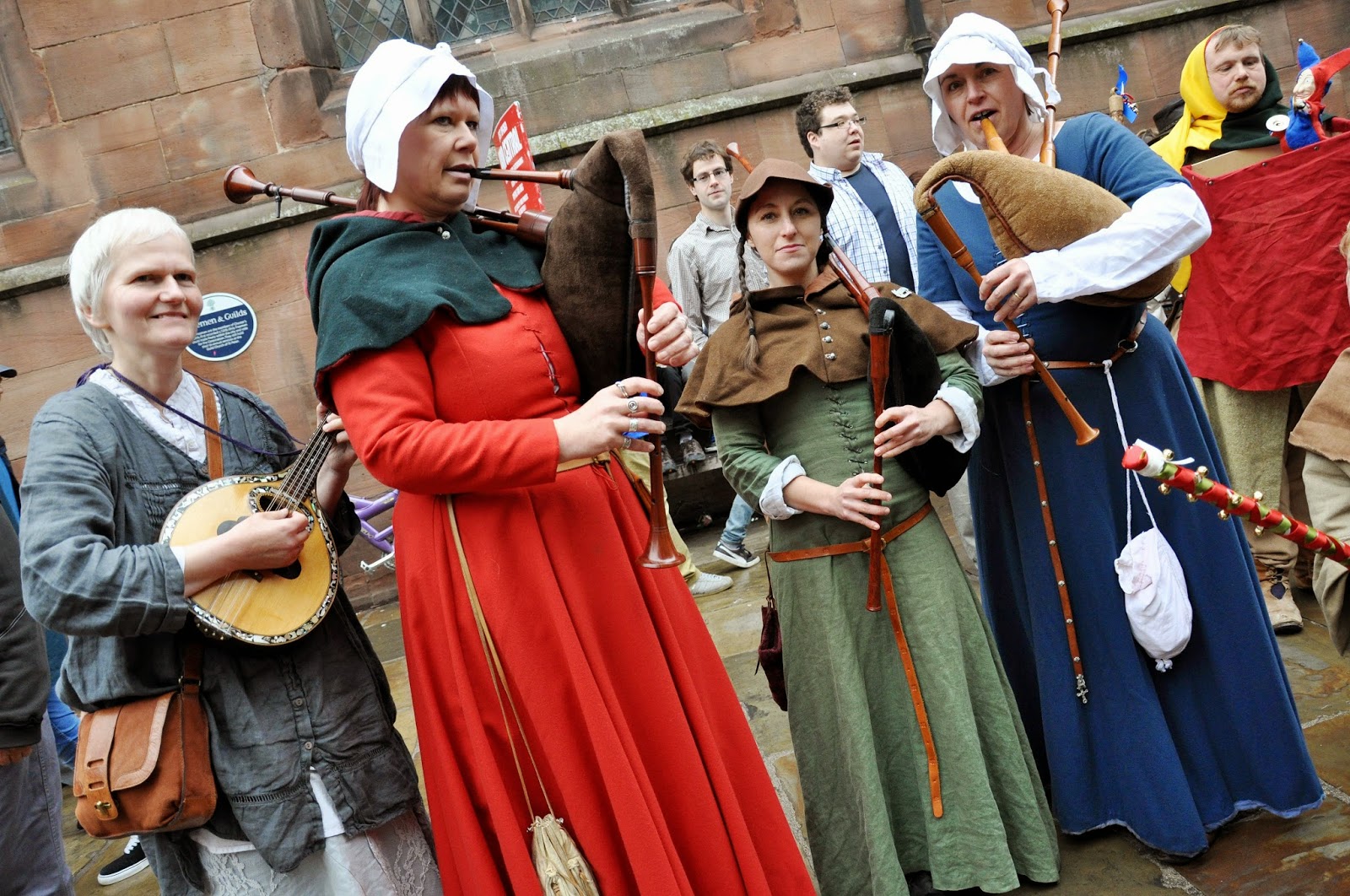
This post is rather belated, though I have shared these pictures elsewhere.  Anyway, this year's Minstrels' Court was another enormous success.  Sue and I (Pilgrims and Posies) organise it in conjunction with the local museum and St John's Church, but it only works due to the wonderful support of the very talented musicians who came from across the UK to help this very special event and enjoy a day of music together.  It is Britain's biggest gathering of medieval musicians and great fun for minstrels and visitors alike.
 
An informal session in the church porch as the day begins.
 
Tom telling the Musicians of Bremen story.
Visitors trying out some medieval board games.
 
Minstrels share news of their new instruments.
 
 
Tom Goodale tells a tale from King Arthur's Court
 
Demonstrating braiding.
 
A knight is armed.
 
The scribe is at work recording the events of the day.
 
Braiding and gossiping.
 
Minstrels processing up Bridge Street.


Minstrels playing at the Cross in the heart of Chester.
 
 
Minstrels at the East Gate of the city.
 
Heading back to the church.
 
A guard waits for the returning minstrels.
 
The gathered minstrels kneel in deference at the altar.
 
Rev David Chesters issues the licences to minstrels.
 
 
A troublesome musitioner is placed in the stocks.
 
The Time Bandits perform a mini-concert as the medieval musicians take a rest after processing.


Summons to the Minstrels' Court

This time of year I find myself excited about the approaching Minstrels' Court and the gathering of so many like minded musicians, living history folk and storytellers, all friends.  Yet, there's also a fair bit of organising to do, and not a little battling with bureaucrats who don't necessarily like the tradition, or indeed understand it.  Each year I wonder whether it will be possible to stage it in future and whether I can face the job of putting it together, but then I remember the story, the tradition, the friends and the fun and it's easy to forget the rest.
 
Now it's only a week and a half to the big day... You are invited of course.
 
Since we first revived the tradition in 2008 it has grown a bit each year and we can now happily call it Britain's biggest medieval music event.
I'm sure many of you will know the legend behind the origin of the Minstrels' Court, but for those who are new to it, here's what I've written about it in the past.
 
And if you want to see what's happened in previous years, we've written about that too!
 
This year, the Minstrels' Court takes place on Saturday 28th June, from 10.30am to 5pm, all in the original and atmospheric location of St John's Church, Chester.  We will be processing through the streets from 1pm to 1.30pm when we return to the church to get our minstrels licences in a recreation of the original ceremony.  There's music from dozens of medieval performers, living history demonstrations, storytelling, children's activities and all of the daytime events are free!
 
Then at 7.30pm, also in the church, there is a concert with Richard and Elizabeth York playing beautiful medieval harp duet, Chester's very own Time Bandits with their lively versions of tunes from medieval to 18th century and Blast from the Past who are one of the country's foremost historic music acts, very upbeat, fun and amazing musicians with it.  These evening concerts have become a highlight in Chester's traditional music calendar and a real treat.  You can get tickets on the door for £5.
 
So do please come along if you can and help to make this a really special day.

That Strange Music - So Darkly Sweet

Back in the summer of last year, we were in Shropshire for a few days exploring before going to Festival at the Edge, the wonderful storytelling and music gathering there. In museums and little towns, we found mentions of Mary Webb, a writer and novelist of the early 20th century who lived in the area and evoked the landscape, traditions and folklore of her native Shropshire in her writings. I confess that neither of us had heard of her before, though her writings are widely known amongst people living in the local area. Sue bought several of her novels in a second hand shop, and has read all of her published writings since then, and now has ended up as a committee member of the Mary Webb Society!
 
We met with a few friends at Festival at the Edge, and one of the highlights of the festival was a performance at the music tent – ‘The Lives and Loves of Mary Webb’ by Beguildy, a duo comprising Anne Marie Summers and Janie Mitchell. Their singing was beautiful and, though they played a good variety of instruments, Anne Marie didn’t play any of her bagpipes for this performance. The songs were actually poems by Mary Webb which they had collected and set to music, it really was a moving and memorable experience and I’m sure I wasn’t the only one who left with tears in my eyes.
But how does any of this relate to bagpipes? Well, in reading her novels, poems and essays, we came across a few mentions of bagpipes. They come from works published in 1917, when we might expect references to reflect the strident sound of Highland pipes or a military aspect, but instead two of the references remark upon the enchanting and hypnotic nature of the bagpipe.
 
Firstly though, a more usual, slightly disparaging view of a bagpipe’s tone, from her novel Gone to Earth.
 
“The one-eyed cat was beside her, blue-ribboned, purring her best, which was like a broken bagpipe on account of her stormy youth.”
 
But later in the same work, she relates a softer, humming tone of a pipe when relating a visit of some of the characters to the bees in a walled garden.
 
“she could hear the queen in one hive ‘zeep-zeeping’ – that strange music which, like the maddeningly soft skirl of bagpipes, or the fiddling of Ned Pugh, has power to lure living creatures away from comfort and full hives into the unknown – so darkly sweet”
 
A similar reference appears in Mary Webb’s collection of nature essays published as ‘The Spring of Joy’ in the same year, 1917.
 
“There the queen bee with her strange, low piping – a mere breath of sound, but stirring the same frenzy as bagpipes played softly before a battle – wakens madness in her followers, and lures them through the gates of adventure as Ned Puw's fiddle inveigled folk through the gates of Faery.”
 
The Ned Pugh, or Ned Puw, she refers to is the character in folk tale of the Shropshire/Wales border, usually a fiddler, though on rare occasion called a piper, who boldly or foolishly, ventures into a cave which leads to the land of the fairies and is never seen again, though his music is often heard under the ground.
 
So, there are only a few references, but I thought them worth sharing as they are some evidence that people were aware of the sweet sound of bagpipes in early 20th century Shropshire, and that I do like the description ‘That strange music – so darkly sweet’.